


⚡ Quick Answer — HYROX Workout
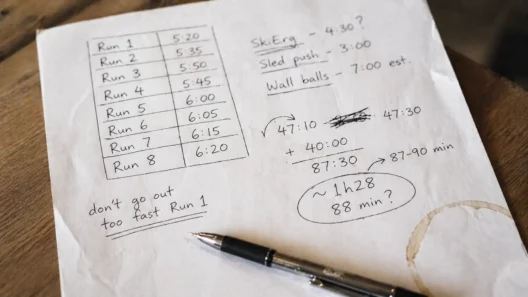
A HYROX workout is the race format itself: 8 × 1 km runs, each followed by one of 8 fixed stations, from the SkiErg to 100 wall balls. In training, the term covers any session that copies that run-station pattern. Median Open finish times sit around 1:28 for men and 1:36 for women.
Most people searching for a HYROX workout want two things: to understand what the race actually asks of their body, and a session they can do this week. Random gym circuits give you neither. A real HYROX workout copies the race’s rhythm, run then station, with fatigue stacking every kilometer.

Sold-out race? HYTRACK catches cancelled spots.
When athletes cancel, tickets silently reappear — and disappear just as fast. HYTRACK monitors every HYROX event and sends you an instant SMS or email alert the second a spot opens up or new tickets drop.
- Sold-out ticket recovery alerts
- New event on-sale notifications
- SMS & email — real-time
- All HYROX events worldwide
We analyzed the published benchmarks from more than 700,000 HYROX race results, a separate study of 460,000+ results, and the official 2026/27 rulebook to build every HYROX workout in this guide around one thing: the finish time you are chasing.
Training is only half the job. Popular races sell out in hours, so if you have not booked yet, set up HYTRACK ticket alerts for HYROX events and get notified when new tickets drop or cancelled spots come back.
What Is a HYROX Workout?
A HYROX workout is a training session or race that alternates 1 km of running with functional stations: SkiErg, sled push, sled pull, burpee broad jumps, rowing, farmers carry, sandbag lunges and wall balls. The race always runs 8 × 1 km plus 8 stations in that fixed order, so training mirrors that run-station-run pattern under fatigue.
The term is used in two ways. Some people mean “the HYROX workout,” the official race itself. Others mean HYROX workouts in the plural: the training sessions gyms and coaches build to prepare you for it.
Both meanings share the same logic. You are never just running and never just lifting. The challenge is producing strength output on tired legs, then running again before your heart rate settles. If you are completely new to the sport, start with our guide to what HYROX is and how a race works.
HYROX Race Format: 8 Stations and Official Weights
Every HYROX workout you build should start from the real loads. The table below follows the official 2026/27 Singles rulebook. Sled weights include the sled itself, farmers carry loads are per hand, and every division completes 100 wall balls.
| Station (after each 1 km run) | Distance / Reps | Women Open | Men Open / Women Pro | Men Pro |
|---|---|---|---|---|
| 1. SkiErg | 1,000 m | No load | No load | No load |
| 2. Sled Push | 50 m (4 × 12.5 m) | 102 kg | 152 kg | 202 kg |
| 3. Sled Pull | 50 m (4 × 12.5 m) | 78 kg | 103 kg | 153 kg |
| 4. Burpee Broad Jumps | 80 m | Bodyweight | Bodyweight | Bodyweight |
| 5. Rowing | 1,000 m | No load | No load | No load |
| 6. Farmers Carry | 200 m | 2 × 16 kg | 2 × 24 kg | 2 × 32 kg |
| 7. Sandbag Lunges | 100 m | 10 kg | 20 kg | 30 kg |
| 8. Wall Balls | 100 reps | 4 kg to 2.70 m | 6 kg (men 3.00 m, women 2.70 m) | 9 kg to 3.00 m |
You can check every figure in the official HYROX Singles Rulebook 2026/27. For pound conversions and Doubles details, see our full breakdown of HYROX weights by division.
Doubles and Relay Loads
Doubles teams use the same loads as singles; the work is shared, not halved. Mixed Doubles uses the Men Open column. Relay teams of four use Open loads only, with each athlete running 2 km and completing 2 stations.
Women Open used to finish with 75 wall balls. That changed in 2024: every division now completes 100 reps. Under the 2026/27 rules, failing to complete a station in full means no valid finish time, so train the full 100.
That full-completion rule is one of several updates this season. Our guide to the HYROX rule changes for 2026 covers the rest.
What Race Data Says About Your HYROX Workout
Before choosing a HYROX workout, look at where races are actually decided. An analysis of 700,000 public results, built on the open-source Pyrox dataset, gives these median finish times by division.
| Division | Median finish time | What it means for training |
|---|---|---|
| Men Open | 1:27:56 | Sub-1:30 = top half |
| Women Open | 1:36:20 | Sub-1:35 = top half |
| Men Pro | 1:20:54 | Strength becomes the limiter |
| Women Pro | 1:26:53 | Heavier sleds and carries |
| Men Doubles | 1:16:13 | Shared stations, full running |
| Women Doubles | 1:28:13 | Shared stations, full running |
| Mixed Doubles | 1:23:05 | Men Open loads |
Source: BOXLIFE’s breakdown of 700,000 HYROX results. Other datasets land a few minutes higher or lower depending on seasons and filters, so treat these as reference points, not exact cut-offs.
Running Still Decides Most Open Races

A study of over 460,000 results across 256 events compared the fastest 15% of athletes with the mid-pack. In Open, running explained about 47% of the time gap, against about 42% for all eight stations combined. In Pro, stations account for roughly half the gap.
The same Hyranking analysis of station time gaps found that burpee broad jumps and wall balls create the largest gaps, while SkiErg and rowing barely separate athletes. In Men Pro, the sled pull was the most decisive station. Note that its women’s data includes seasons when Women Open did 75 wall balls.
The takeaway for your HYROX workouts: protect your running, then fix burpee broad jumps, wall balls, sled pull and lunges. For per-station benchmarks, see our HYROX station times by division and our ranking of the hardest HYROX stations. Age-specific targets are in HYROX average time by age group, and women-specific data is in our guide to the HYROX average finishing time for women.
The 4 Types of HYROX Workouts
Almost every good HYROX workout falls into one of four categories. Each one trains a different part of race reality, so a solid week uses at least three of them.
1. Full Race Simulation
A full simulation means 8 × 1 km runs and all 8 stations at race weight. It is the most specific HYROX workout you can do, and also the most costly in recovery.
Use it as a test, not a weekly habit: once every 4–6 weeks, and no closer than 10–14 days before race day. Record every split so you can compare progress honestly.
2. Half Simulation
A half simulation covers either stations 1–4 or stations 5–8 with a 1 km run before each. You get race-specific fatigue in 35–50 minutes without wrecking the rest of your week.
The back half is the more valuable one. Burpee broad jumps, lunges and wall balls on tired legs are where most athletes slow down.
3. Station Circuits
Station circuits group 2–4 movements into short, repeatable blocks, often as an EMOM or AMRAP. They build technique and muscular endurance with less running volume.
- Example: 4 rounds of 500 m row, 20 wall balls, 50 m farmers carry, 10 burpee broad jumps.
- Rest 90 seconds between rounds and keep every round within 10 seconds of the first.
4. Compromised Running Intervals
Compromised running means running hard right after a station, when your legs feel heavy. This is the most race-specific running you can do, and the data says running matters most.
- Example: 5 rounds of 1 km at goal race pace, then 25 wall balls or 15 burpee broad jumps.
- Goal: your fifth 1 km is no more than 10–15 seconds slower than your first.
For pacing targets per kilometer, read our guide to HYROX running pace and how to train running for HYROX.
Sample 4-Day HYROX Workout Week

This sample week fits athletes who already train 3–5 hours a week. Place a rest day or easy day between the two hardest sessions, and add an easy 30–45 minute run if you have time.
| Day | Session | Focus |
|---|---|---|
| Day 1 | Compromised running: 5 × (1 km at goal pace + 1 station) | Running under fatigue |
| Day 2 | Strength: squats, deadlifts, sled push/pull, carries | Sled power and grip |
| Day 3 | Easy run 30–45 min + station technique (SkiErg, row) | Aerobic base and recovery |
| Day 4 | Half simulation (stations 5–8) or station circuit | Race-specific endurance |
Every 4–6 weeks, swap Day 4 for a full simulation. If you are unsure how much volume you can handle, start with our guide to how much training you need for HYROX, or follow the structured HYROX training plan.
Doing a full HYROX workout simulation every week is the fastest way to stall. You accumulate fatigue without enough quality running or strength work. Test monthly, train in between.

Station-by-Station HYROX Workouts
Use these short blocks as finishers or as part of a station circuit. Each one targets the specific way a station breaks down in a race.
SkiErg
The SkiErg comes first, so the risk is going out too hard. Do 4 × 500 m at a pace you could hold for 1,000 m, with 1 minute rest. More in our SkiErg training guide.
Sled Push and Sled Pull
Both sleds reward steady force over speed. Do 6 × 12.5 m push plus 6 × 12.5 m pull at race weight or slightly heavier, with a 200 m run between sets. See our sled push and pull methods.
Burpee Broad Jumps
This station opens the widest gaps, so rhythm beats max jumps. Do 4 × 20 m with 45 seconds rest, then 1 × 40 m straight after a 1 km run. Details in our burpee broad jump guide.
Rowing
The row is a chance to control breathing before the farmers carry. Do 3 × 1,000 m at race effort, holding a steady stroke rate, with 2 minutes rest.
Farmers Carry
Grip, not legs, usually ends this station. Do 4 × 100 m at race weight with 60 seconds rest, plus dead hangs at the end of strength days. See our farmers carry training methods.
Sandbag Lunges
Lunges arrive when quads are already cooked. Do 3 × 50 m at race weight right after 500 m of running, focusing on a full knee touch every rep.
Wall Balls
Plan your sets before you are tired. Do 1 km run, then 100 wall balls in fixed sets (for example 5 × 20), and time the whole block. More in how to train wall balls for HYROX.
HYROX Workouts by Target Time
This is where most HYROX workout advice falls short: it gives everyone the same session. A first-timer chasing a finish and an athlete chasing sub-1:10 need different intensities, different volumes and different weak points.
We built the time budgets below from the median data above and our own station benchmarks. It is a pacing model, rounded to the nearest 5 seconds, not official splits. Running is set at 55% of non-RoxZone time and stations at 45%.
| Target time | Avg run pace / km | Total running | Total stations | RoxZone budget |
|---|---|---|---|---|
| First finish (~1:45) | 6:30 | ~52 min | ~43 min | ~10 min |
| Sub-1:30 | 5:40 | ~45 min | ~37 min | ~8 min |
| Sub-1:20 | 5:00 | ~40 min | ~33 min | ~7 min |
| Sub-1:10 | 4:25 | ~35 min | ~29 min | ~6 min |
Here is how that station budget splits across the race for each target:
| Station | ~1:45 | Sub-1:30 | Sub-1:20 | Sub-1:10 |
|---|---|---|---|---|
| SkiErg | 5:45 | 4:55 | 4:25 | 3:50 |
| Sled Push | 3:30 | 3:00 | 2:40 | 2:20 |
| Sled Pull | 3:45 | 3:15 | 2:50 | 2:30 |
| Burpee Broad Jumps | 6:35 | 5:40 | 5:05 | 4:25 |
| Rowing | 6:15 | 5:25 | 4:50 | 4:15 |
| Farmers Carry | 3:05 | 2:40 | 2:20 | 2:05 |
| Sandbag Lunges | 5:55 | 5:05 | 4:35 | 4:00 |
| Wall Balls | 7:55 | 6:50 | 6:05 | 5:20 |
Your own split will not match the model exactly. A strong runner can bank time on the runs and spend more on sleds; a strong lifter does the opposite. To get a personal estimate, plug your numbers into our HYROX finish time estimator, and compare with how long HYROX takes by division.
First Finish (around 1:45): Build the Engine
Your priority is finishing every station without walking the runs. Most of your weekly volume should be easy running and technique at race weight.
- Key HYROX workout: 4 rounds of 1 km easy run + half a station (500 m ski, 25 m sled push, 40 m burpee broad jumps, 50 wall balls).
- Success marker: all runs at a conversational pace, no station abandoned.
New to racing? Our HYROX training plan for beginners builds this base week by week.
Sub-1:30: Hold Pace After Stations
At this level, the gap is usually your runs drifting from 5:40 to 6:30 per km in the second half. Compromised running is your main lever.
- Key HYROX workout: 6 × (1 km at 5:40/km + 20 wall balls or 50 m lunges), 90 seconds rest.
- Success marker: last kilometer within 15 seconds of the first.
Sub-1:20: Remove Station Breaks
Here, unplanned breaks on wall balls, burpee broad jumps and lunges cost more than slow running. You need station endurance at race weight, under fatigue.
- Key HYROX workout: back-half simulation (1 km + 80 m BBJ, 1 km + 1,000 m row, 1 km + 200 m carry, 1 km + 100 m lunges, 1 km + 100 wall balls).
- Success marker: wall balls in your planned sets, no extra breaks, total station time close to the model.
Sub-1:10: Speed Plus Strength Reserve
At sub-1:10 you need roughly 4:25/km running and sleds that feel manageable, not maximal. Strength reserve is what keeps your post-sled kilometers fast.
- Key HYROX workout: 4 × (1 km at 4:20/km + 12.5 m heavy sled push at 110% race weight + 12.5 m sled pull), 2 minutes rest.
- Success marker: run splits stable, sled lengths unbroken.
If you are approaching this level, check the HYROX Pro requirements before choosing your next division.
HYROX Workout Equipment You Actually Need
You can train most of a HYROX workout in a standard gym. The items below cover what you need to copy race conditions, ranked by how hard they are to replace.
- SkiErg and rower: no real substitute for race pacing.
- Sled with a rope: if your gym has none, use heavy prowler pushes or banded resisted runs.
- Wall ball at your race weight: 4, 6 or 9 kg, plus a target marked at 2.70 m or 3.00 m.
- Kettlebells and a sandbag: for carries and lunges.
- Shoes and a watch: grip on turf and reliable lap splits.
For tested picks, see our best HYROX equipment for 2026, the best shoes for HYROX and the best watch for HYROX.
Common HYROX Workout Mistakes
Most stalled athletes are not lazy. They are doing the wrong HYROX workout for their level, or doing the right one too often.
- Training stations fresh: a sled push after a warm-up tells you little about a sled push after 2 km of running.
- Using lighter weights: if you never train at race load, race day becomes a strength test.
- Skipping easy running: without an aerobic base, every station costs more recovery.
- Ignoring RoxZone: transitions add several minutes; rehearse moving straight from station to run.
- Starting the first kilometer too fast: see what happens in your first HYROX race when you start too fast.
For the time sinks we see most often on race day, read where most athletes lose time in HYROX.
Quick Action Plan
Turn this guide into your next four weeks with these steps.
- Pick your target time and division, then note your run pace and station budget from the tables above.
- Run one benchmark: a half simulation of stations 5–8 at race weight.
- Find your two slowest stations versus the model.
- Follow the 4-day week, adding those two stations to your circuits.
- Repeat the benchmark after 4 weeks and compare every split.
Not sure where your fitness puts you? Run your numbers through the HYROX finish time estimator before you pick a target, then lock in a race with HYTRACK’s HYROX ticket alerts so a sell-out does not decide for you.
Training tips & HYROX insights
Join the list — guides, race strategies and performance content, straight to your inbox.
FAQ
What are HYROX workouts at a regular gym?
HYROX workouts at a regular gym are sessions that mix running with the race stations, using a treadmill, rower, SkiErg, sled and wall balls. Many gyms now run official HYROX Training Club classes. Formats vary, but the best ones always include running under fatigue.
What is the OTF HYROX workout?
OTF stands for Orangetheory Fitness, which became an official HYROX affiliate partner in November 2025. Select studios that opted in offer HYROX-themed classes built on treadmill, rowing and strength blocks. It is a training class, not an official race, and content varies by studio.
How long does a HYROX workout take?
The race takes most Open athletes between about 1:15 and 1:50, with medians near 1:28 for men and 1:36 for women. Training sessions are shorter: 45–75 minutes for most workouts, and 35–50 minutes for a half simulation.
Can I do a HYROX workout without a sled?
Yes, but it is a compromise. Heavy prowler pushes, resisted band runs and heavy step-ups can stand in. Try to get on a real sled at race weight at least a few times before race day.
How many HYROX workouts should I do per week?
Most amateurs do well with 2–3 HYROX-specific sessions per week, plus easy running and strength. More than that usually adds fatigue faster than fitness.
Is a HYROX workout good for beginners?
Yes, if you scale it. Use shorter runs, half distances and lighter loads at first, then progress to race weight. Read can anyone compete in HYROX if you are unsure whether you are ready.
For official formats and standards, refer to the official HYROX website.