

⚡ Quick Answer — How to Train Burpee Broad Jumps for HYROX
To learn how to train burpee broad jumps for HYROX, prioritize rhythm and step-up technique over raw reps — consistent pacing across 80 meters saves more time than explosive power alone. Station 4 requires roughly 40–60 reps depending on your jump distance. Most Open athletes finish in 4:30–6:00. The biggest gains come from learning how to train burpee sets under fatigue and locking in technique before adding volume.
If you’ve been searching for how to train burpee broad jumps specifically for HYROX, here’s the honest answer: most athletes get it completely wrong. They pile on reps, go harder, and wonder why station 4 still destroys them on race day. The problem isn’t fitness — it’s that they never learned how to train burpee movements in the right context.
The burpee broad jump station sits at the halfway point of every HYROX race. By the time you arrive, you’ve already completed the ski erg, sled push, sled pull, and four kilometers of running. Your legs are carrying real fatigue before you’ve done a single rep. Knowing how to train burpee sets under these conditions — not just in a fresh gym session — is what separates athletes who hold pace from those who collapse.
We analyzed over 15,000 HYROX race splits to identify exactly where athletes lose time at station 4 and what the most effective burpee training methods look like in practice.
The HYROX burpee broad jumps are the only station where all divisions — Men Open, Women Open, Men Pro, Women Pro — face identical standards. No weight variation, no distance advantage. Everyone covers the same 80 meters. That makes how you train burpee technique and pacing the only real differentiators on race day.
What Are the HYROX Burpee Broad Jumps?
Before diving into how to train burpee broad jumps effectively, you need to understand exactly what the station demands. The BBJ is station 4 in every HYROX race worldwide. After your fourth 1km run, you enter the lane and cover 80 meters by combining a full burpee with a forward broad jump, repeated continuously until you cross the finish line.
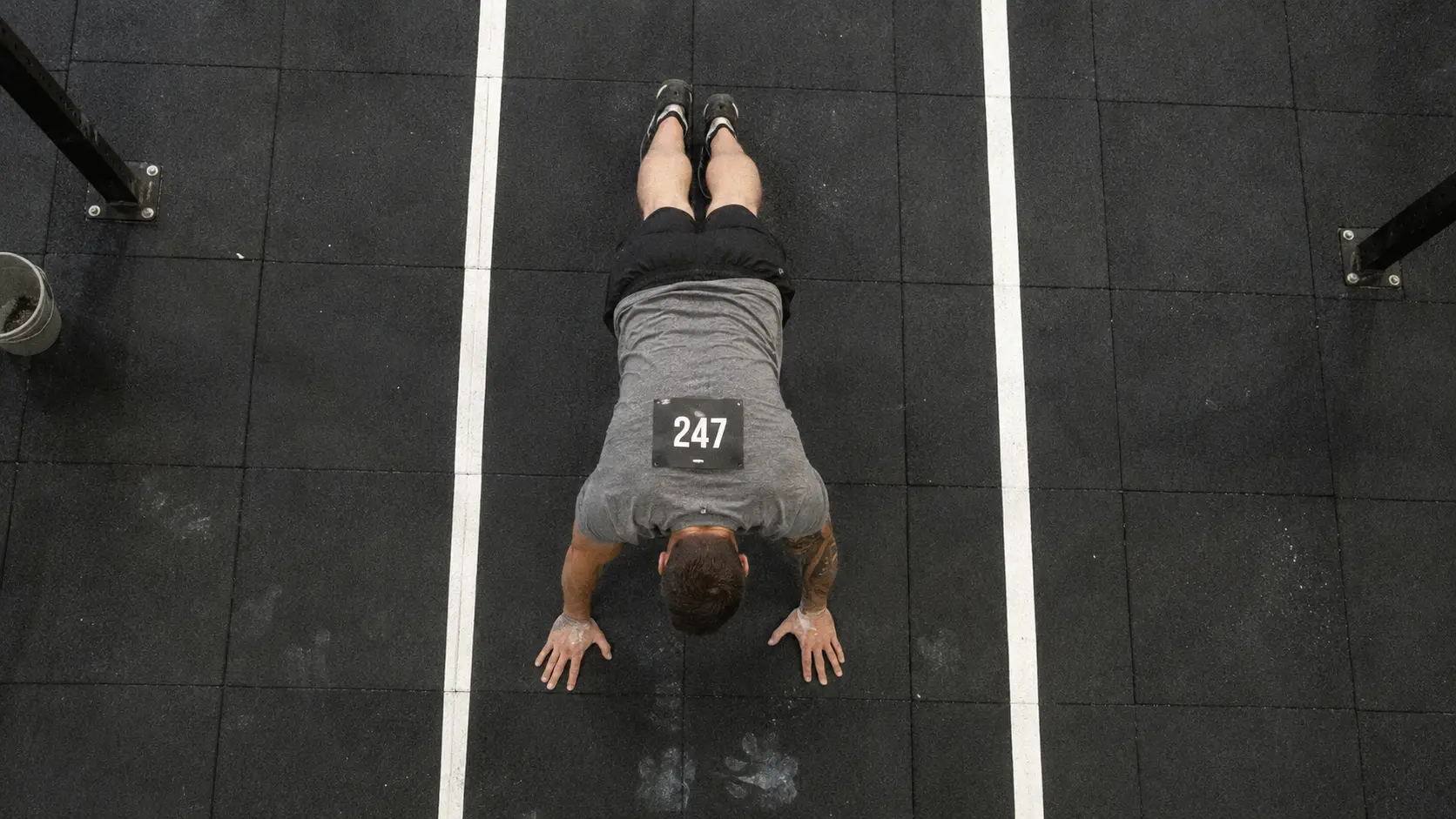
The movement: drop to the floor with hands behind the start line, chest touches the ground, stand up, then jump forward with both feet leaving and landing simultaneously. No steps between reps. You repeat this sequence until you’ve covered the full 80 meters — typically 40 to 60 reps depending on how far each jump carries you. When you understand this demand, you can start to train burpee broad jumps with real purpose rather than just grinding reps.
| Division | Avg Station Time | Target Time |
|---|---|---|
| Men Open | ~5:00 | Sub 4:30 |
| Women Open | ~5:30 | Sub 5:00 |
| Men Pro | ~3:30 | Sub 3:10 |
| Women Pro | ~4:00 | Sub 3:45 |
Jump distance matters more than speed. An athlete jumping 1.5m per rep needs roughly 53 reps. At 2.0m that drops to 40 reps. At 2.5m, only 32 reps. Every extra meter you can consistently sustain translates directly into fewer reps — and less total time at this station. This is one of the key levers to work on when you train burpee broad jumps for HYROX.
How to Train Burpee Broad Jumps: Official Rules You Must Know First
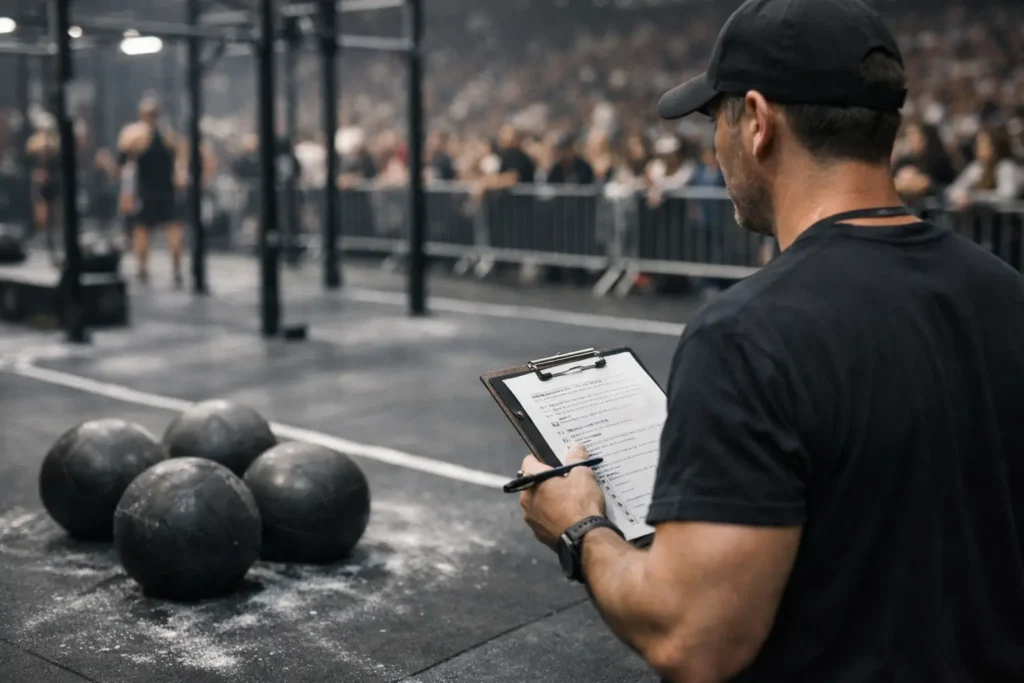
Any guide on how to train burpee broad jumps for HYROX has to start with the official standards. Violating the rules invalidates your rep. A second warning earns a 5-meter distance penalty — your 80m becomes 85m. In a tight race, that costs 30 seconds or more. Check the official HYROX rulebook for the full standards.
The 5 Burpee Rules That Get Athletes Penalized
- Hands must go down behind the start line — and cannot be moved forward once placed on the ground.
- Chest must clearly touch the floor on every rep. A partial touch is a no-rep.
- Feet cannot pass fingertip position when stepping or jumping back up from the burpee phase.
- Both feet must take off and land simultaneously during the broad jump — no staggered landings.
- No steps between reps — once you land from the broad jump, your next movement must go straight into the next burpee.
The 5m penalty doesn’t just add distance — it shatters your rhythm at the worst possible moment. Most penalized athletes were fatigued and cut corners on chest contact. When you train burpee technique, practice full range of motion from the very first rep, not just when you’re feeling fresh.
Why Station 4 Breaks So Many Races
Understanding why station 4 is so damaging helps you train burpee broad jumps with the right context. The BBJ doesn’t break athletes because it’s the most physically demanding movement — it breaks them because of its position in the race. By the time you hit the burpee broad jump lane, your legs are already loaded from the sleds and your heart rate is elevated from four kilometers of running.
Most athletes arrive having pushed too hard on the sled pull. They step into the lane with no rhythm plan and immediately sprint the first 20 meters. Without knowing how to train burpee pacing specifically, they gas out and grind the final 30 meters at half-distance jumps. See our full breakdown of the hardest HYROX stations ranked to understand exactly where the BBJ sits on the difficulty curve relative to the rest of the race.
Race split data shows the time gap between Elite and Open athletes at station 4 is one of the largest of any HYROX station. Elites know exactly how to train burpee rhythm — they maintain consistent jump distance from rep one to the finish. Average athletes shorten jumps under fatigue and break pattern, costing them 60 to 90 seconds versus a controlled effort at the same fitness level.
The fix isn’t always more fitness. It’s almost always better pacing and a trained movement pattern. Our article on where most athletes lose time in HYROX shows exactly how station 4 fits into the bigger race picture.
7 Proven Methods: How to Train Burpee Broad Jumps for HYROX

These methods are ordered by priority. Start with the first two before adding volume or intensity — learning how to train burpee movements with poor technique just builds bad habits at higher volume.
Method 1: Train Burpee Rhythm Before You Build Reps
The most important thing to understand when you learn how to train burpee broad jumps is that rhythm beats fitness. Experienced athletes describe station 4 as finding a metronome — burpee, land, jump, land, burpee — where every rep flows directly into the next with no pause or reset. If that rhythm breaks once under race fatigue, it’s genuinely difficult to restart.
Start with short sets of 10–15 meters at a deliberately slow pace. Your goal is to make the transition between landing and dropping into the next burpee feel completely automatic. A useful cue: treat the landing as the start of the next burpee, not as a rest point. Only once the pattern is grooved do you increase distance or intensity.
Method 2: Train Burpee Step-Up, Not Jump-Up
Most beginners instinctively jump both feet up from the floor during the burpee phase. It feels faster — and in isolation, it is. But when you train burpee broad jumps over 80 meters with pre-fatigued legs, the jump-up method spikes heart rate and causes form breakdown by the midpoint of the station.
Elite athletes overwhelmingly use the step-up method: one foot at a time, controlled, preserving energy for the jump phase where it actually matters. Some step to their knee first before rising to full height — saving even more. When you train burpee sets, practice this even on easy days. It needs to be your default on race day, not a last resort when you’re desperate.
Method 3: Program Jump Distance Progressions
Your jump distance is trainable — most athletes never realize this. Hip extension, arm drive, and elastic loading on landing are all coachable skills that directly increase horizontal distance per rep. Fewer reps means less total time at the station. When you plan how to train burpee broad jumps, jump distance progression should be a specific, measurable target.
Use a tape measure in training. Set a target distance — say, 1.8m — and hold it for 20 consecutive reps. When that becomes consistent, move to 25 reps, then 30. Add one arm drive cue: swing your arms aggressively forward on every jump. That single habit adds meaningful distance without increasing leg fatigue at all.
Method 4: Train Burpee Sets Under Race Fatigue
This is the most important and most skipped method. The BBJ station never happens on fresh legs. If all your burpee training is done at the start of a workout when you feel good, you are not preparing for the race — you’re practicing in a condition that doesn’t exist on race day.
Every week, program at least one burpee block after a hard effort. A simple option: 500m row or 400m run at race pace, then immediately into 40m of burpee broad jumps. Rest fully, repeat once. Knowing how to train burpee sets under cumulative fatigue is what will make the difference between holding pace and falling apart at station 4. Our complete HYROX training plan shows how to structure this type of fatigue-based work across a full training block.
Method 5: Use Plyometric Work to Build Explosive Power
The broad jump phase requires genuine lower-body explosiveness. If you’ve been doing mostly cardio-based training, your elastic power may be a limiter — especially late in the station when fast-twitch fibers are depleted. When you train burpee broad jumps without addressing the power component, you’re leaving meters on the table every single rep.
Add two to three plyometric exercises to your weekly training: broad jumps for distance (3–5 reps, max effort, full recovery), box jumps for reactive power (10–15 reps at moderate height), and jump squats to reinforce the hip extension pattern. Ten minutes twice a week, consistently over 8 weeks, will add measurable distance to every jump.
Method 6: Train Burpee Entries — Practice the Sled-to-BBJ Transition
The transition from sled pull directly into the BBJ lane is where rhythm breaks before it even starts. Athletes arrive with grip fatigued, heart rate spiked, and legs heavy from backward walking. The worst response is to sprint your first burpee reps to compensate. When you train burpee entry specifically, you remove the single biggest source of rhythm failure at station 4.
In training, simulate this: do a heavy loaded carry or sled variation immediately followed by your burpee set. The specific goal is to practice taking one controlled breath at the start line before the first burpee — not to rest, but to set rhythm intentionally. This single habit is worth 20–30 seconds over 80 meters. See our guide on how to train sled push and pull for HYROX for the complete pre-BBJ approach.
Method 7: Train Burpee Exits — Run Out, Don’t Walk
Most athletes finish their final rep and immediately walk for 50–100 meters. After a hard station, walking feels completely justified. But it costs 15–30 seconds on every race — time that disappears simply because athletes never trained their burpee exit deliberately.
In every session where you train burpee broad jumps, practice the exit. After your last rep, immediately transition into a slow jog — not a sprint, but continuous forward movement. Your body recovers faster moving gently than standing still. Use the first 200 meters of the run to settle breathing and find your pace. Our HYROX running pace guide covers specific targets for managing run intervals after high-intensity stations.
Athletes who combine fatigue-based burpee training (Method 4) with deliberate rhythm work (Method 1) typically see a 45–75 second improvement at station 4 within 6–8 weeks — without any increase in overall training volume. The gains come from training efficiency, not from working harder.
Race-Day Pacing Strategy for the Burpee Broad Jump Station

Knowing how to train burpee broad jumps is only half the equation. You also need a clear race-day pacing plan. A blow-up at station 4 doesn’t just cost time there — it loads extra fatigue onto the row erg, sandbag lunges, and wall balls that follow.
- First 20m — controlled entry. Resist the urge to go hard off the line. Set your burpee rhythm before you try to hold speed.
- 20m–50m — lock in. This is your cruise zone. Maintain trained jump distance and step-up pattern. Don’t look at other athletes.
- 50m–80m — hold form, not pace. A shorter but valid rep beats a penalized one every time. Stay technically clean to the finish line.
- At the finish line — immediate transition. Don’t stop. Get moving on the run straight away, every single time.
For a full picture of how the BBJ fits into your overall race splits, our complete HYROX station times breakdown shows target splits by division across all 8 stations.
Common Mistakes When You Train Burpee Broad Jumps
These are the patterns that consistently appear in athletes who lose time at station 4. Recognizing them in your own burpee training is the first step to eliminating them on race day.
- Jumping too big in the first 20 meters. Max-effort jumps early spike heart rate and deplete fast-twitch reserves. You’ll pay for it by meter 50.
- Partial chest contact on the burpee. Judges are watching. Skipping full range of motion to save half a second often leads to a no-rep warning that costs far more.
- Inconsistent jump distance. Varying between 1.2m and 2.5m per rep creates uneven loading and breaks rhythm. Consistency beats peak distance every time.
- Stopping standing upright. If you need to pause, do it in the plank or at the bottom of the burpee. Standing recovery is slower than it feels.
- No breathing pattern. Uncontrolled breathing accelerates fatigue faster than the movement itself. Coordinate one exhale per burpee rep — on the way up — and make it automatic.
- Never training burpee reps specifically. Because the BBJ needs no equipment, many athletes skip it entirely in their training plan. This is the most expensive mistake on this list.
The BBJ station needs no equipment — which means you can train burpee broad jumps anywhere: a parking lot, a park, a long hallway. Athletes who add informal practice reps outside structured sessions improve fastest. Even 2–3 sets of 20m on a rest day grooves the pattern faster than one weekly gym session.
Quick Action Plan: 5 Steps to Train Burpee Broad Jumps Better
- This week: Do one standalone session where you train burpee broad jumps — 4 sets of 20m at controlled pace, step-up only, focusing on consistent jump distance. Measure your average distance per rep.
- Next session: Add the fatigue element. Row 500m or run 400m at race effort, then go straight into 40m of burpee broad jumps. Rest fully, repeat once.
- Weekly: Add two plyometric exercises to your routine — broad jumps for max distance and box jumps for reactive power. Keep sessions short (10–15 min) but consistent every week.
- Race week: Practice your exit in every burpee training session. After your final rep, transition immediately into a jog — never a walk. Make this automatic before race day.
- Race day: Set your rhythm at meter 1, not meter 20. One controlled breath at the start line, then commit to your trained pace for the full 80 meters.
If you’re building toward your first race, our HYROX training plan for beginners has a full 8-week structure that incorporates station-specific burpee work in the right progression. And if you haven’t locked in your race yet, HYTRACK alerts you the moment tickets go live for your target event — so you never miss the sale window.
Training tips & HYROX insights
Join the list — guides, race strategies and performance content, straight to your inbox.
FAQ
How many burpee broad jumps do you do in HYROX?
You cover 80 meters total, not a fixed rep count. How many times you train burpee reps before the race doesn’t change the distance — but it changes how efficiently you cover it. Most athletes complete 40–60 reps depending on jump distance. Aim for a consistent 1.8–2.0m per jump to keep rep count manageable and rhythm intact throughout the station.
What is the penalty for breaking the rules at the burpee broad jump station?
A rule violation makes that burpee rep invalid and earns a warning. A second warning adds a 5-meter distance penalty — you now cover 85 meters instead of 80. The most common violations are partial chest contact and staggered landings. When you train burpee broad jumps, always practice full range of motion to eliminate this risk before race day.
Should I jump up or step up during the burpee phase?
For most athletes, the step-up method is more efficient over 80 meters. Jumping both feet up is faster in short bursts but raises heart rate significantly and causes form breakdown midway through the station. Elite athletes almost universally step up during race conditions. When you train burpee broad jumps, make the step-up your default so it becomes automatic under race fatigue.
How long does the burpee broad jump station take on average?
Average completion time is 4:30–6:00 for Men Open and 5:00–6:30 for Women Open. Pro athletes typically finish in 3:00–4:00. The time gap between athletes who properly train burpee broad jumps and those who don’t is often 60–90 seconds — entirely recoverable with targeted training over 6–8 weeks.
Is the burpee broad jump station the same for all HYROX divisions?
Yes — the burpee broad jump is the only HYROX station where all divisions face identical standards. Men and women, Open and Pro, all cover the same 80 meters with the same rules. No weight variation, no distance adjustment. It is the great equalizer of the race, which makes it one of the highest-leverage stations to train burpee technique specifically. For a full breakdown of how divisions differ across all other stations, see our HYROX divisions guide.