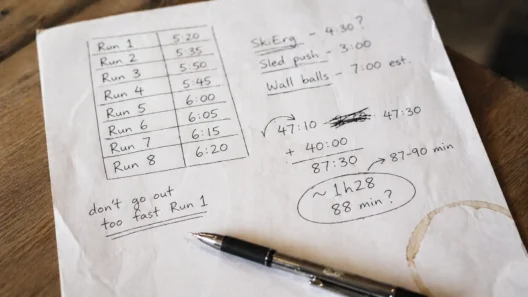



⚡ Quick Answer — HYROX Running Pace: 7 Proven Splits to Never Blow Up Again
Your HYROX running pace should be 15–25% slower than your standalone 5km race pace — sustainable enough to survive all 8 runs and 8 stations. Most athletes blow up by km 4–5 because they start too fast and underestimate station fatigue. A negative split strategy — running the back half slightly faster than the front — consistently produces better finish times across all divisions.
Most athletes don’t lose a HYROX race at the stations. They lose it on the run — specifically on runs 4, 5, and 6 when their legs are already fried and their pace falls apart. Getting your HYROX running pace right from the start is the single highest-leverage decision you’ll make on race day.
Whether it’s your first race or your fifth, the question is always the same: how fast should I actually be running between stations? Too slow and you leave time on the table. Too fast and you’re crawling by the Sandbag Lunges.
We analyzed over 40,000 HYROX finish records across Open, Pro, and Doubles divisions to map how running pace degrades across all 8 km segments — and built a practical framework you can apply immediately to your training and race day strategy.
This guide covers HYROX running pace strategy for both beginners targeting a sub-90 finish and intermediates chasing sub-75. The benchmarks and split rules apply across all divisions.
What Is a Good HYROX Running Pace?

There’s no single “good” HYROX running pace — it depends entirely on your division, your fitness base, and how well you manage station fatigue. But there are clear benchmarks that separate athletes who finish strong from those who suffer through the last three runs.
The key principle: your HYROX running pace is not your open running pace. Every km you run is preceded by a station that has already taxed your legs, your lungs, or both. A 5:00/km runner in a standalone 5km might be running 6:15–6:30/km by km 7 of a HYROX if they haven’t trained and paced correctly.
| Division | Target Finish | Target Pace/km | Total Run Time |
|---|---|---|---|
| Open Men (Beginner) | 90–110 min | 6:30–7:30/km | 52–60 min |
| Open Men (Intermediate) | 75–90 min | 5:30–6:30/km | 44–52 min |
| Open Women (Beginner) | 95–115 min | 7:00–8:00/km | 56–64 min |
| Open Women (Intermediate) | 80–95 min | 6:00–7:00/km | 48–56 min |
| Pro Men | 55–65 min | 3:45–4:30/km | 30–36 min |
| Pro Women | 62–72 min | 4:15–5:00/km | 34–40 min |
These ranges reflect the HYROX running pace that corresponds to consistent, repeatable splits — not the pace you could hold for a single km on fresh legs. For a deeper breakdown by age group, check the HYROX average time by age group guide.
Why Your HYROX Running Pace Breaks Down (And Where)
Understanding why your HYROX running pace deteriorates is just as important as knowing what pace to target. The breakdown isn’t random — it follows a predictable pattern tied to station order and cumulative fatigue.
The Station Fatigue Effect
Each HYROX station doesn’t just cost you time — it pre-loads fatigue that hits you on the next run. The Sled Push and Sled Pull (stations 2 and 3) target your posterior chain and quads directly. By the time you exit station 3, your legs are already running on a deficit. Your HYROX running pace for km 4 will almost always be slower than km 1, even if it doesn’t feel like it in the moment.
The Sandbag Lunges (station 7) are the most destructive to running economy. Most athletes see their worst HYROX running pace on km 8 — not because they’re unfit, but because 100m of lunges under load destroys quad elasticity. Knowing this in advance lets you distribute effort smarter across the first six runs.
The Early Blowup Trap
The single most common pacing mistake in HYROX is a km 1 that’s 60–90 seconds faster than sustainable HYROX running pace. Race adrenaline, the crowd, and fresh legs combine into a pace that feels easy — until km 5 when you’re redlining and walking between stations.
If your km 1 feels easy, you are almost certainly running too fast for your target HYROX running pace. The correct pace should feel controlled, slightly uncomfortable, and sustainable. Not a jog — but not a race effort either.
If you’ve already raced and blew up mid-race, you’re not alone. The article on starting too fast in your first HYROX race covers exactly why this happens and how to reprogram your race-day instincts.
HYROX Running Pace Benchmarks by Division
The following benchmarks reflect realistic, achievable HYROX running pace targets for each division — based on median finish data, not elite outliers. Use these as a starting point, then adjust based on your 5km time test (covered in the next section).
| Km Segment | Open Men ~85 min | Open Women ~95 min | Pro Men ~60 min |
|---|---|---|---|
| Km 1 (Fresh) | 5:50 | 6:30 | 3:55 |
| Km 2 | 6:00 | 6:40 | 4:00 |
| Km 3 | 6:05 | 6:45 | 4:05 |
| Km 4 (post-Sled) | 6:15 | 6:55 | 4:10 |
| Km 5 | 6:20 | 7:00 | 4:10 |
| Km 6 | 6:25 | 7:05 | 4:15 |
| Km 7 (post-Farmers) | 6:30 | 7:10 | 4:15 |
| Km 8 (post-Lunges) | 6:40 | 7:20 | 4:20 |
Notice the natural progression: the target HYROX running pace slows by roughly 5–10 seconds per km as stations accumulate. Athletes who ignore this curve and try to maintain km 1 pace throughout consistently blow up in the second half. You can cross-reference these splits with the full HYROX station time breakdowns to build your complete race plan.
Athletes who accept a natural HYROX running pace decline of 45–60 seconds total from km 1 to km 8 tend to finish stronger — and often faster overall — than those who fight the fade with ego pacing.
How to Set Your HYROX Running Pace Before Race Day

Guessing your target HYROX running pace on race day is a recipe for disaster. The right approach is to calculate it in training, weeks before the event, using a simple two-step process.
The 5km Time Test
Run a standalone 5km at maximum effort. Record your average pace per km. This is your baseline. Your target HYROX running pace should be 15–25% slower than this number — depending on your current level of strength and conditioning.
- If your 5km pace is 4:30/km → target HYROX running pace: 5:10–5:30/km
- If your 5km pace is 5:00/km → target HYROX running pace: 5:45–6:15/km
- If your 5km pace is 5:30/km → target HYROX running pace: 6:20–6:50/km
- If your 5km pace is 6:00/km → target HYROX running pace: 6:50–7:30/km
- If your 5km pace is 6:30/km → target HYROX running pace: 7:30–8:00/km
Apply the lower end of the range (15% slower) if you have solid strength training behind you. Apply the upper end (25% slower) if you’re primarily a runner without much gym background, or if this is your first HYROX. The stations will cost you more than you expect.
Building Your Target Splits
Once you have your target HYROX running pace, build a simple split card. Write down the expected time for each of the 8 km runs — accounting for the natural fade curve in the table above. Add 10–15 seconds per km from km 4 onwards. This card goes on your wrist or forearm on race day.
During training, practice running at your target HYROX running pace immediately after completing station simulations — not on fresh legs. The skill you’re building isn’t just cardiovascular; it’s the ability to find and hold your pace when you’re already fatigued. For a full training structure around this, see the HYROX training plan.
7 Proven Pacing Rules for Every HYROX km
These seven rules define the framework behind every successful HYROX running pace strategy — from km 1 through km 8. Apply them in order and you’ll never blow up mid-race again.
- Cap km 1 at your target pace, no exceptions. Adrenaline will push you faster. Your watch is the only voice that matters in that first loop. A km 1 that’s 30 seconds too fast can cost you 3–4 minutes in the back half.
- Use the first 200m of each run to recover, not accelerate. Exit the station, control your breathing, find your rhythm. The first 200m is a buffer — use it. Your actual HYROX running pace target kicks in from 200m onwards.
- Don’t check your pace, check your effort. Your heart rate and breathing should be your primary feedback. A pace watch is a secondary tool. Racing by feel after enough training will always outperform staring at a number.
- Expect km 4 and km 8 to feel harder — plan for it. These are post-Sled and post-Lunges runs. They will feel disproportionately difficult. Your HYROX running pace goal here is simply to not walk — not to hit a time.
- Negative split the second half if you can. If you’ve paced the first 4 km conservatively, you’ll have reserves for km 5–8. Aim for km 6 and km 7 to be 5–10 seconds faster than your km 3 and km 4. This is how top athletes close races.
- Shorten your stride after heavy stations, don’t slow your cadence. Post-Sandbag Lunges, your stride length will drop naturally. Maintain cadence (steps per minute) and let the stride length recover over 200–300m. This protects your HYROX running pace without overloading already-stressed muscle tissue.
- The last 400m of km 8 is a sprint. Everything you’ve saved is spent here. No pacing, no strategy — just execution. This is where a strong finish is built or lost.
Rule #2 is the one most athletes skip. Exiting a station at a sprint feels productive — it costs you 60–90 seconds of oxygen debt that hits 400m later. The 200m buffer is not optional; it’s where your HYROX running pace is actually recovered.
How to Adjust Your HYROX Running Pace After Each Station

Not all stations impact your HYROX running pace equally. Some require a longer recovery buffer before you can settle into your target km pace. Others are low enough impact that you can push through with minimal adjustment. Knowing the difference is a competitive advantage most athletes don’t have.
High-Impact Stations That Kill Your Run
These stations will significantly disrupt your HYROX running pace if you don’t account for them with a 200–300m recovery buffer after exiting:
- Sled Push (Station 2): Maximal quad and glute effort. Legs will be heavily loaded. Expect 200–250m at reduced pace before your running economy recovers.
- Sled Pull (Station 3): Similar posterior chain load. Km 4 is statistically the most common blowup point in HYROX. Budget extra buffer here.
- Burpee Broad Jumps (Station 4): Cardiovascular spike, not a leg killer — but your heart rate will be 10–15 bpm higher than your running target. Slow the first 200m of km 5 to bring HR down before settling into your HYROX running pace.
- Sandbag Lunges (Station 7): The most damaging to running mechanics. Your stride will be shortened, your quads will be burning. Accept a slower km 8 target — 10–20 seconds per km slower than your average HYROX running pace.
Lower-Impact Stations You Can Push Through
These stations allow you to re-enter your target HYROX running pace faster — within the first 100–150m of the following run:
- SkiErg (Station 1): Upper body dominant. Your legs are fresh going into km 2. This is often the fastest run of the race.
- RowErg (Station 5): Seated, full-body effort but not destructive to running mechanics. Re-enter pace within 100–150m.
- Farmers Carry (Station 6): Grip and core load. Your legs are used but not destroyed. The km 7 run is often underestimated — you can push the pace here.
- Wall Balls (Station 8): Followed by the finish line, not another run. Go all out.
Understanding which station precedes each run gives you a complete map of where to push and where to protect your HYROX running pace. For a full breakdown of which stations are hardest overall, see the hardest HYROX stations ranked.
Common Pacing Mistakes (And How to Fix Them)

Even experienced athletes make consistent errors with their HYROX running pace. Here are the five most damaging — and exactly how to correct them before your next race.
- Mistake 1: Using a road race pace as your HYROX baseline. Your half-marathon pace has nothing to do with your HYROX running pace. Use the 5km time test method above. Fix: recalibrate with a fresh test and apply the 15–25% reduction formula.
- Mistake 2: No wrist split card. Racing from memory almost always produces inconsistent pacing. Fix: write your per-km targets on your forearm with a marker before the race. Simple, effective, used by elites.
- Mistake 3: Treating all 8 runs as equal. Your km 4 HYROX running pace target should not be the same as km 1. Fix: use a progressive fade model (5–10 seconds slower per km from km 3 onwards) and build it into your split card.
- Mistake 4: Sprinting into stations. Many athletes accelerate the last 100m before a station — then immediately start the station at full effort. This spikes HR and costs time on both the run and the station. Fix: decelerate 50m before the station, enter controlled.
- Mistake 5: Not training the specific transitions. Your HYROX running pace after a Sled Push in training will be different from race day if you’ve never practiced that exact sequence. Fix: brick workouts. Sled Push → 1km run at pace. Sandbag Lunges → 800m run. These are non-negotiable in the 6 weeks before a race. The HYROX beginner training plan includes exactly this type of session.
Quick Action Plan: Set Your HYROX Running Pace in 5 Steps
Here’s everything in one place. Follow these five steps and you’ll arrive on race day with a clear, tested HYROX running pace strategy — not a guess.
- Run a standalone 5km time trial. All-out effort, flat course, no warm-up jog included. Record your average pace per km. This is your baseline number.
- Calculate your target HYROX running pace. Multiply your 5km pace by 1.18 (18% slower) if you have a strong conditioning base. Use 1.22 (22% slower) if you’re newer to strength work or this is your first HYROX.
- Build your 8-split card. Start at your target pace for km 1–3. Add 5–8 seconds for km 4–5 (post-Sled zone). Add another 5 seconds for km 6–7. Accept km 8 as 15–20 seconds slower than your base target.
- Practice your pace in training. Do at least 4 brick workouts in the 6 weeks before race day. Each session: simulate 2–3 consecutive station + run combinations at your target HYROX running pace. This trains your body to find the pace when fatigued.
- Execute on race day: anchor to km 1. Your first km sets the tone for everything that follows. Write your km 1 target on your wrist. Run that pace. Adjust from there.
For official race formats and standards, refer to the official HYROX website.
If you want to track how your target pace aligns with real finish times, the HYROX average finishing time guide gives you division benchmarks to calibrate against.
And if you haven’t yet secured your race entry, use HYTRACK to get instant alerts when tickets go on sale — races sell out fast and knowing your pace strategy only matters if you’re actually in the race.
FAQ
What is a good HYROX running pace for a beginner?
For most beginners, a target HYROX running pace of 6:30–7:30/km is realistic and sustainable across all 8 km segments. The priority at this level isn’t speed — it’s consistency. Finishing all 8 runs without walking is the real benchmark. Use the 5km time test and apply a 22–25% reduction to get your starting target.
How much does HYROX running pace slow down across the race?
Most athletes see a natural HYROX running pace decline of 45–75 seconds per km from km 1 to km 8 — and this is completely normal. Elite athletes experience a smaller drop (15–25 seconds total) due to conditioning and pacing discipline. The key is to build the fade into your plan rather than treating it as a failure.
Should I use a GPS watch to track my HYROX running pace?
Yes — a GPS watch set to display pace per km is the most effective tool for managing your HYROX running pace in real time. Set alerts for your target range so the watch vibrates if you go over or under. In a noisy exhibition hall, audio feedback is unreliable; haptic alerts work better. Pair the watch with a wrist split card for backup.
Is it better to run a negative split in HYROX?
A modified negative split — where the second half of the race is slightly faster than the first — is the most effective HYROX running pace strategy for intermediate athletes. It requires disciplined pacing in km 1–4 and reserves capacity for a stronger finish on km 5–8. True negative splits are difficult due to station fatigue, but relative to most athletes’ instincts, erring toward conservative early pacing almost always produces better results.
How do I train to hold my HYROX running pace under fatigue?
Brick workouts are the most specific tool for training your HYROX running pace under fatigue. Structure sessions around 2–3 consecutive station simulations followed immediately by a 600–1000m run at race pace. Do this 2–3 times per week in the final 6 weeks before your race. Your body learns to find the pace even when fatigued — and that’s the skill that separates athletes who hold their splits from those who don’t.
What is the hardest run in HYROX from a pacing perspective?
Km 8 — after the Sandbag Lunges — is the hardest run to maintain your target HYROX running pace on. The Sandbag Lunges directly destroy the quad and glute mechanics needed for efficient running. Most athletes experience their slowest km split here. Budget for it by running km 6 and km 7 slightly faster than target if you feel strong — then accept km 8 as your slowest split and sprint the final 400m.
Training tips & HYROX insights
Join the list — guides, race strategies and performance content, straight to your inbox.