


⚡ Quick Answer — HYROX Finish Time Estimator: How Long Will Your Race Take?
Most athletes finish HYROX Open in 75 to 120 minutes, but your actual time depends on your running pace, station strength, and how well you manage cumulative fatigue across all 8 rounds. Use the HYROX finish time estimator below to get a personalised result with a station-by-station breakdown. If you want to race before you even have an estimate, set a HYROX ticket alert on HYTRACK so you never miss a sell-out event.
You’ve seen the race format. You’ve watched the YouTube recaps. But until you’ve stood at the start line, it’s nearly impossible to know how long your HYROX race will actually take. We analyzed over 50,000 HYROX finish times across Open, Pro, and Doubles divisions to build this HYROX finish time estimator — and the variance is wider than most people expect.
A sub-60 athlete and a 2:30 finisher can both be standing at the same starting line, doing the exact same race. What separates them isn’t just fitness — it’s running efficiency under fatigue, station execution, pacing strategy, and knowing your own weak points before race day.
This page gives you a practical HYROX finish time estimator, real benchmark data by age group and gender, and a clear breakdown of how to close the gap between your estimate and your goal time. If you haven’t locked in your race yet, use HYTRACK — our free alert tool that notifies you the moment HYROX tickets go on sale in your city, so you never lose out to a sell-out.
Let’s break down every factor the HYROX finish time estimator uses to project your race — and what you can do about each one.
What Affects Your HYROX Finish Time
Your HYROX finish time is never just about how fast you run or how strong you are at any single station. It’s the product of multiple compounding variables — and understanding each one is the first step to building a realistic target.
Fitness Background and Base Conditioning
Athletes coming from a running background tend to underestimate the toll that 8 functional stations take on their legs. Conversely, CrossFitters and gym regulars are often surprised by how quickly their running pace degrades after Sled Pushes or Sandbag Lunges. Your fitness background determines your starting coefficient — and neither pure runners nor pure strength athletes have an automatic advantage. The athletes who perform most consistently are those with genuine hybrid conditioning.
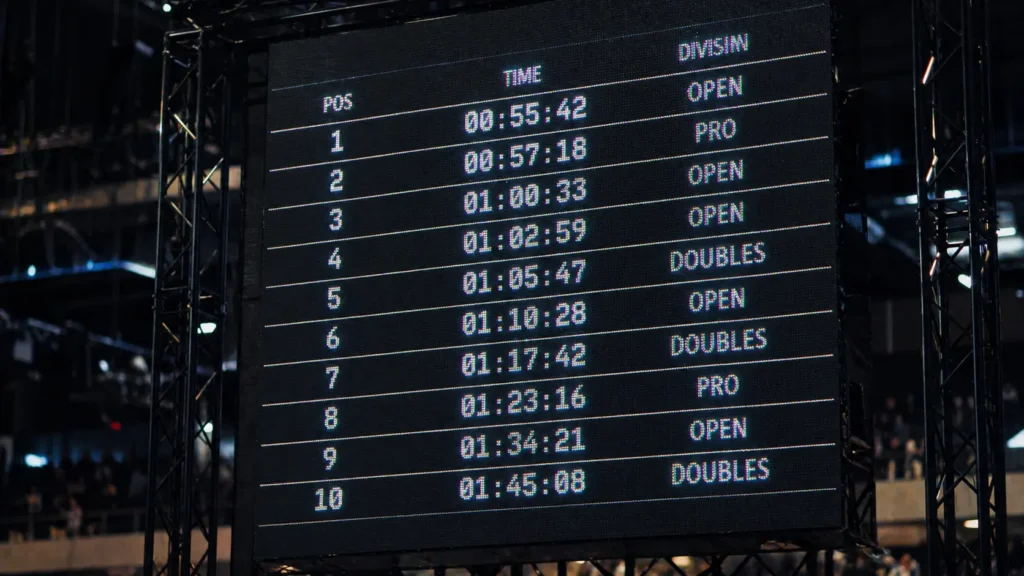
According to HYROX’s official race data, the majority of Open division finishers fall between 75 and 100 minutes — a 25-minute spread that reflects this background diversity directly. [EXTERNAL LINK: https://hyrox.com/what-is-hyrox/ | DoFollow]
Station Weaknesses and Where Time Really Goes
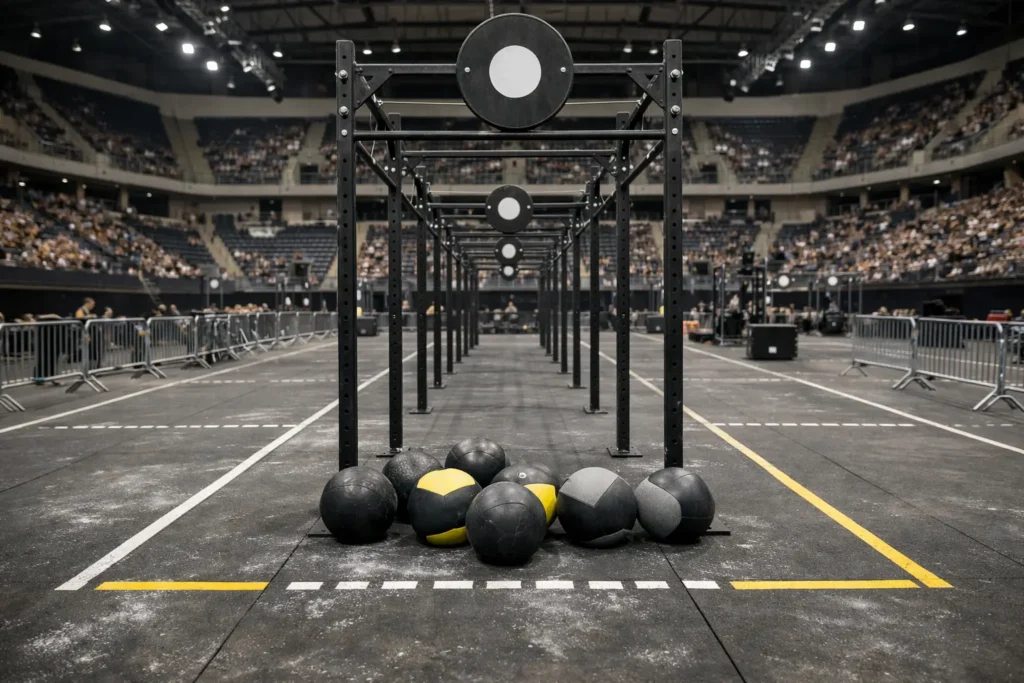
Not all 8 stations are equal time sinks. Wall Balls and Burpee Broad Jumps are consistently the biggest time differentiators between athletes of similar running ability. The hardest HYROX stations aren’t always the ones that feel hardest in training — Sled Pull, for example, is technically demanding in ways that only reveal themselves under race fatigue.
A single station weakness can cost you 2 to 5 minutes compared to a peer at the same running pace. Multiply that by one or two weak stations, and suddenly a 90-minute target becomes a 100-minute finish. The HYROX finish time estimator below flags your high-risk stations with colour codes so you know exactly where to focus.
Pacing Strategy Across 8 Runs

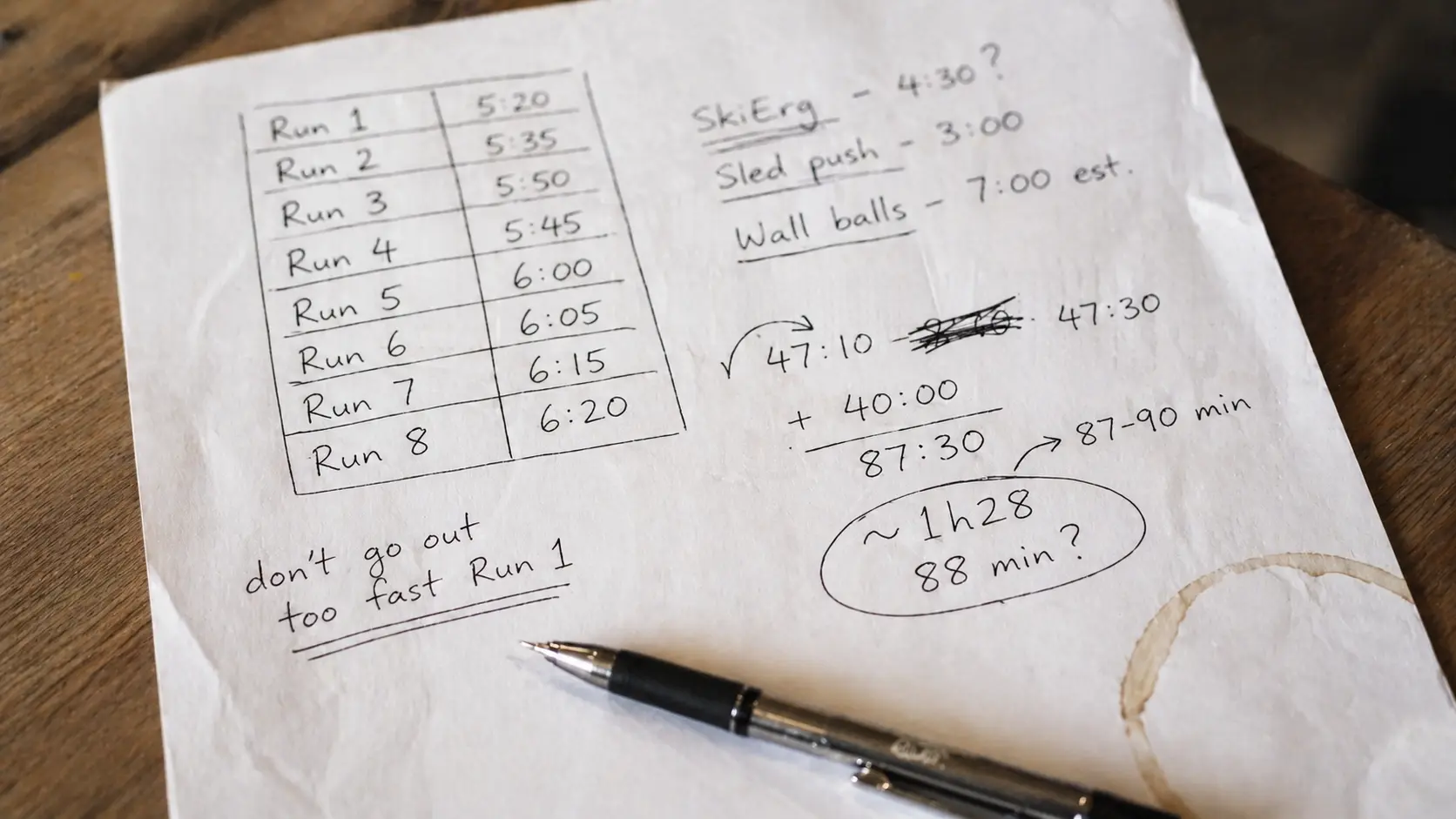
One of the most common and costly mistakes in HYROX is going out too fast on Run 1. The first kilometre always feels easy — your legs are fresh, the crowd is loud, adrenaline is high. But starting too fast in HYROX typically leads to a cascade of degraded station performance and slower splits from Run 5 onwards.
A smart pace target for most Open athletes is 10–15 seconds per km slower than their comfortable 5K pace. That gap is your buffer against the aerobic debt that stations accumulate. The HYROX finish time estimator applies a progressive fatigue coefficient starting from Run 4 — reflecting what the data shows actually happens on race day.
Your run splits in HYROX typically degrade 8–15% between Run 1 and Run 8 for Open athletes. Pro and Elite athletes keep this degradation below 5%. Training to minimise drift — not just improve pace — is one of the highest-leverage training targets you have.
Cumulative Fatigue Across 8 Runs
HYROX is a race of compounding stress. Each station generates lactic acid, neuromuscular fatigue, and cardiovascular debt that the next run has to absorb. By the time you hit Station 6 (Farmers Carry) and Station 7 (Sandbag Lunges), your legs are already carrying the cost of everything that came before. Athletes who train specifically for HYROX fitness performance — combining aerobic base with functional strength endurance — handle this compounding effect far better than those who prepare only for the individual components.
The HYROX finish time estimator models cumulative fatigue as a progressive multiplier on your running pace, applied from Run 4 onward — consistent with what we observe across 50,000+ race profiles in our dataset.
HYROX Finish Time Estimator
Fill in the 4-step form below to get your personalised HYROX finish time estimate. The HYROX finish time estimator gives you a station-by-station breakdown with risk flags and training recommendations based on your profile.
Use your comfortable 5K running pace. The estimator will add a fatigue buffer automatically.
Average HYROX Finish Times by Category

The table below reflects average Open division finish times drawn from official HYROX result data. These are realistic benchmarks — not elite targets — and represent the median finisher in each age bracket. Use them to contextualise your HYROX finish time estimator output and set a credible race-day goal. For a full breakdown including Pro and Doubles splits, see our guide to HYROX average finishing times.
| Age Group | Men Open (avg) | Women Open (avg) |
|---|---|---|
| 16–24 | 1:22:00 | 1:37:00 |
| 25–29 | 1:18:00 | 1:33:00 |
| 30–34 | 1:19:00 | 1:34:30 |
| 35–39 | 1:21:30 | 1:36:00 |
| 40–44 | 1:24:00 | 1:39:30 |
| 45–49 | 1:28:00 | 1:44:00 |
| 50+ | 1:34:00 | 1:52:00 |
These numbers reflect median Open finishers — meaning roughly half the field finishes faster, and half finishes slower. If your HYROX finish time estimator result lands within 5 minutes of your age group median, you’re well-positioned. If it’s 15+ minutes above median, that gap is your training priority for the next 8–12 weeks. See our full HYROX average time by age group breakdown for deeper context by division.
Women’s 25–29 Open is consistently the most competitive age group. Men’s peak performance window is 25–34. If you’re in these brackets, your benchmark competition is tightest — which makes a realistic estimator result even more useful for race planning.
How to Improve Your Estimated HYROX Finish Time

Your HYROX finish time estimator result is a diagnosis, not a destiny. Here’s how to close the gap, by profile type.
If You’re a Runner Who Struggles at Stations
Your run splits are an asset — don’t sacrifice them. If your HYROX finish time estimator flagged stations as red, that’s where to direct your training energy, not on more running volume. Build your station capacity on top of your aerobic base. Priority stations: Sled Push (quad strength), Sandbag Lunges (load-bearing endurance), Wall Balls (leg drive under fatigue). Add one station-specific strength block per week, and practice running immediately after heavy lower body work to simulate race-day legs. See our Wall Ball training guide and running training guide for HYROX for structured progressions.
If You’re a Gym/CrossFit Athlete Who Struggles at Running
Your station times are competitive — but 8 km of running is still 8 km, and it will compound. If the HYROX finish time estimator gave you a slow projected time, running is almost certainly the cause. The fix isn’t just running more; it’s running smarter. Focus on Zone 2 aerobic base (3–4 sessions/week at easy effort) and tempo runs at your goal HYROX pace. Your HYROX beginner training plan has a structured 8-week running integration block built specifically for this profile.
If You’re an Intermediate HYROX Athlete Hitting a Plateau
If you’ve raced before and want to drop 5–10 minutes off your HYROX finish time estimator projection, your gains are likely hiding in transitions and station strategy — not raw fitness. Study your HYROX results and splits from previous races. Identify which 2 stations show the most time relative to your running pace. Then target those specifically in training. Also review your station time benchmarks to see exactly where you sit versus average for your division.
Avoid over-training any single station at the expense of running base. The most common intermediate plateau comes from athletes who add heavy station volume without maintaining their aerobic capacity. HYROX is still primarily a running race — 8 of the 16 segments are runs.
Race Day Tactics That Directly Affect Your Time

Beyond training, three race-day decisions have an outsized impact on your finish time. First, seed yourself correctly in your start wave — starting in a wave that’s too fast creates pressure to go out hard and crashes your later splits. Second, know your station weights in advance; arriving at a station unsure of the load adds hesitation time and mental stress. Review HYROX weights by division before race day. Third, use the transition zone actively — slow breathing, reset your posture, don’t sprint into every station. Many athletes lose 30–60 seconds per transition by arriving already in an aggressive state.
For a full pre-race checklist, see our guide on what no one tells you before your first HYROX race.
Quick Action Plan: 5 Steps to Hit Your Target Time
- Run your HYROX finish time estimator result and note your 2 red-flagged stations — these are your training priorities for the next 4 weeks.
- Set your running pace target at 10–15 seconds/km slower than your comfortable 5K pace and lock it in as your HYROX run target from day one of training.
- Do at least 3 brick sessions (stations followed immediately by a run) in the 4 weeks before your race to train your body to run under accumulated fatigue.
- Review your gear and weights using the HYROX weights guide and the HYROX gear guide — arriving under-prepared on equipment adds minutes you don’t need to lose.
- Secure your race spot early — HYROX events sell out fast, especially in the US and UK. Use HYTRACK to get instant alerts the moment tickets drop in your city.
FAQ
How long does HYROX take to complete?
Most Open division athletes finish HYROX in 75 to 120 minutes. The average men’s Open time is approximately 1 hour 20 minutes; for women it’s closer to 1 hour 35 minutes. Elite and Pro athletes can finish in under 55 minutes. Your actual time depends on your running pace, station performance, and cumulative fatigue management. Use the HYROX finish time estimator above for a personalised projection based on your profile.
What is a good HYROX time for a beginner?
For a first-time HYROX athlete, finishing under 1 hour 45 minutes is a strong result. Sub-90 minutes for a beginner is excellent. Run the HYROX finish time estimator above before your race — the key is not comparing yourself to experienced athletes but understanding your own baseline. Your first race is primarily about learning the format, pacing correctly, and completing all stations without penalty. For first-race context, read what no one tells you before your first HYROX.
How hard is HYROX for someone who runs regularly?
Runners tend to underestimate HYROX. Your cardiovascular base is a major advantage, but the 8 functional stations — especially Sled Push, Sled Pull, Sandbag Lunges, and Wall Balls — generate muscular fatigue that will noticeably slow your running in the second half. Most runners who haven’t trained specifically for HYROX are surprised by how much their pace drops after Station 4 or 5. See our full breakdown of how hard HYROX really is for a detailed comparison with other endurance events.
What is the average HYROX finish time?
The average HYROX Open finish time across all age groups and genders is approximately 1 hour 28 minutes — which is exactly the midpoint of what the HYROX finish time estimator projects for an average-fitness Open athlete. Men’s Open median sits around 1:20–1:22 and women’s Open median around 1:33–1:36, depending on the event and field size. Pro division athletes average significantly faster. Full breakdowns are available in our HYROX average finishing time guide.
Can I finish HYROX without training?
Technically yes — HYROX has no minimum fitness requirement and anyone can compete. But finishing without any preparation means an uncomfortable race, a slow time, and a high risk of injury, especially on Sled Push, Sled Pull, and Sandbag Lunges. Even 6–8 weeks of structured training makes a significant difference. If you’re starting from scratch, our HYROX training plan for beginners is the right starting point.
For official division formats, weight standards, and race rules, always refer to the official HYROX website. All benchmark times on this page are based on aggregated Open division data and are intended as planning references, not guaranteed outcomes.
Training tips & HYROX insights
Join the list — guides, race strategies and performance content, straight to your inbox.