


⚡ Quick Answer — HYROX Weights Explained
HYROX weights are standardized loads used at 5 of the 8 workout stations and they change by division: Men Open and Women Pro use a 152 kg (335 lb) sled push, Women Open uses 102 kg (225 lb), and Men Pro uses 202 kg (445 lb). Wall balls range from 4 kg to 9 kg depending on division. The SkiErg, RowErg and Burpee Broad Jumps involve no external load.
Most athletes discover the real challenge of HYROX weights on race day, not in training. The loads themselves are not extreme. What makes them brutal is arriving at each station already fatigued, with a spiked heart rate and heavy legs from the previous run.

Sold-out race? HYTRACK catches cancelled spots.
When athletes cancel, tickets silently reappear — and disappear just as fast. HYTRACK monitors every HYROX event and sends you an instant SMS or email alert the second a spot opens up or new tickets drop.
- Sold-out ticket recovery alerts
- New event on-sale notifications
- SMS & email — real-time
- All HYROX events worldwide
Before you plan your training around the loads, make sure you actually have a bib. The HYTRACK ticket alerts page tells you the moment tickets go on sale or a spot reopens, so you do not miss your event to a sell-out.
×

The first real space for HYROX athletes — race talk, training tips, finding a doubles partner. Free, and growing.
Join on Telegram → Free to join · No app requiredWe analyzed over 18,000 race results and athlete performance splits across Open and Pro divisions to show where athletes lose the most time on weighted stations, and what separates those who manage the loads from those who collapse under them.
What Are the Official HYROX Weights?
The official HYROX weights are fixed, global standards applied at five of the eight stations: Sled Push, Sled Pull, Farmers Carry, Sandbag Lunges and Wall Balls. Every event worldwide, from London to New York, uses the same loads for each division, which keeps results comparable across races.
Here is the full chart for the 2026/27 season in kilograms and pounds. Sled weights include the sled itself, and farmers carry loads are per hand.
| Station | Women Open | Men Open / Women Pro | Men Pro |
|---|---|---|---|
| Sled Push (incl. sled) | 102 kg (225 lb) | 152 kg (335 lb) | 202 kg (445 lb) |
| Sled Pull (incl. sled) | 78 kg (172 lb) | 103 kg (227 lb) | 153 kg (337 lb) |
| Farmers Carry (per hand) | 16 kg (35 lb) | 24 kg (53 lb) | 32 kg (71 lb) |
| Sandbag Lunges | 10 kg (22 lb) | 20 kg (44 lb) | 30 kg (66 lb) |
| Wall Balls | 4 kg (9 lb) | 6 kg (13 lb) | 9 kg (20 lb) |
Women Pro uses the same loads as Men Open. The sled weights include the sled itself, so if you train with your own sled, subtract its base weight to know how many plates to load.
New 2026 Sled Design: What Changed and What Didn’t
In September 2026, HYROX introduced a modified competition sled with replaceable metal runners, as reported by Hybrid Fitness Media. On the previous design, replacing worn runners meant taking the sled apart, and wear could change the friction between the sled and the carpet.
The official HYROX weights stay exactly the same: 102 kg and 78 kg for Women Open, 152 kg and 103 kg for Men Open and Women Pro, 202 kg and 153 kg for Men Pro. The distance is still 50 m for both the push and the pull. For other recent changes, see our guide to the HYROX rule changes for 2026.
Identical sleds with identical loads can still feel different from lane to lane, because the condition of the surface changes friction. Train the sled on more than one surface so race day does not surprise you.
HYROX Weights by Division — Full Breakdown
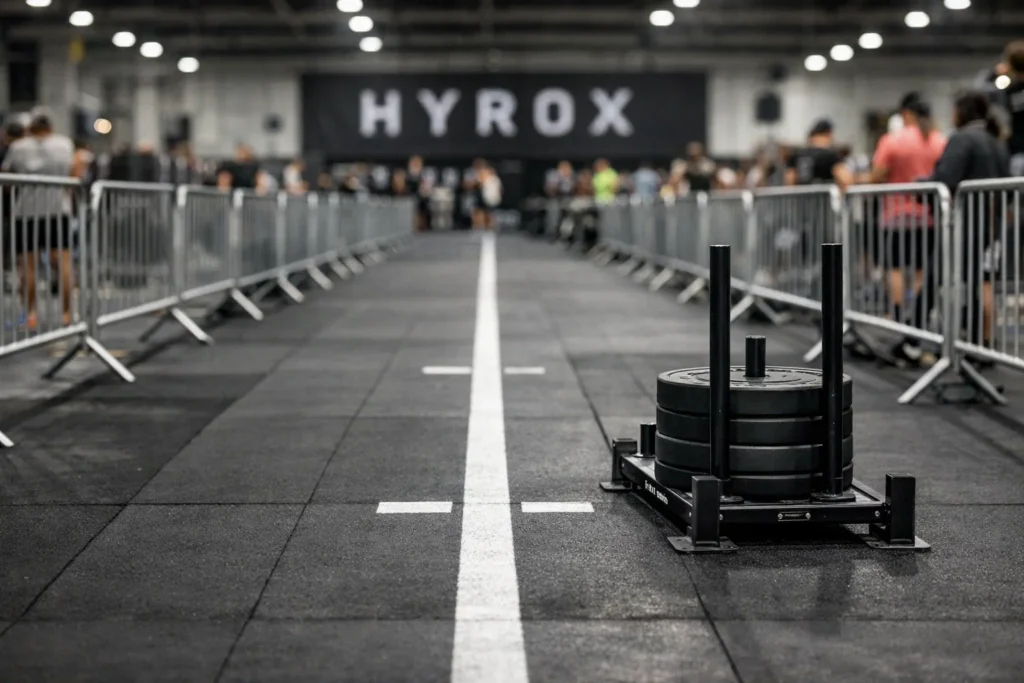
The HYROX weights differ significantly depending on the division you enter. The gap between Open and Pro is the biggest jump, not just in absolute load, but in the physiological demand it creates over an 8-station race. Here is each division with its distances and reps.
Open Division Weights
Open is the entry-level competitive division, with moderate loads that are challenging but accessible with proper preparation. Most first-time competitors enter Open. Strength is a factor, but endurance and pacing remain the main race-day differentiators.
| Station | Distance / Reps | Open Men | Open Women |
|---|---|---|---|
| Sled Push | 50m | 152 kg | 102 kg |
| Sled Pull | 50m | 103 kg | 78 kg |
| Farmers Carry | 200m | 2× 24 kg | 2× 16 kg |
| Sandbag Lunges | 100m | 20 kg | 10 kg |
| Wall Balls | 100 reps | 6 kg | 4 kg |
Pro Division Weights
Pro is where the loads become genuinely demanding. The sled push increases to 202 kg for Pro Men, 50 kg heavier than Open Men. Pro Women push 152 kg, the same load as Open Men, so a woman moving from Open to Pro steps up to the load Open Men already face. Pro athletes need race-specific strength that transfers under high fatigue, not just gym numbers.
| Station | Distance / Reps | Pro Men | Pro Women |
|---|---|---|---|
| Sled Push | 50m | 202 kg | 152 kg |
| Sled Pull | 50m | 153 kg | 103 kg |
| Farmers Carry | 200m | 2× 32 kg | 2× 24 kg |
| Sandbag Lunges | 100m | 30 kg | 20 kg |
| Wall Balls | 100 reps | 9 kg | 6 kg |
Do not enter Pro unless you are consistently comfortable with the Open loads in training simulations. The jump from Open to Pro is not just 50 kg on the sled, it reshapes your entire pacing strategy.
Not sure which division fits your level? The 5-step guide to choosing your HYROX division helps you decide, and the HYROX Pro requirements explain what it takes to qualify.
Doubles & Relay Weights
Doubles and Relay use the same loads as singles, and your category decides which set applies. Women’s Open Doubles and Women’s Relay use the Women’s Open weights. Men’s Open Doubles and Mixed Doubles use the Men’s Open weights. Pro Doubles teams use the Pro loads for their gender, so Pro Men weights for men’s teams and Pro Women weights for women’s teams. Always confirm your exact category on the official HYROX website before race day.
In Doubles, partners can share the work at each station, which reduces the muscular demand per athlete, but the load on the sled and the carries stays identical to the singles equivalent. Relay athletes complete only two stations each, so the impact per person is lower, though the sled push or farmers carry still hurts in a competitive relay. If you race as a pair, the HYROX doubles strategy guide shows how to split the stations.
The 5 Weighted Stations Where HYROX Weights Hurt Most
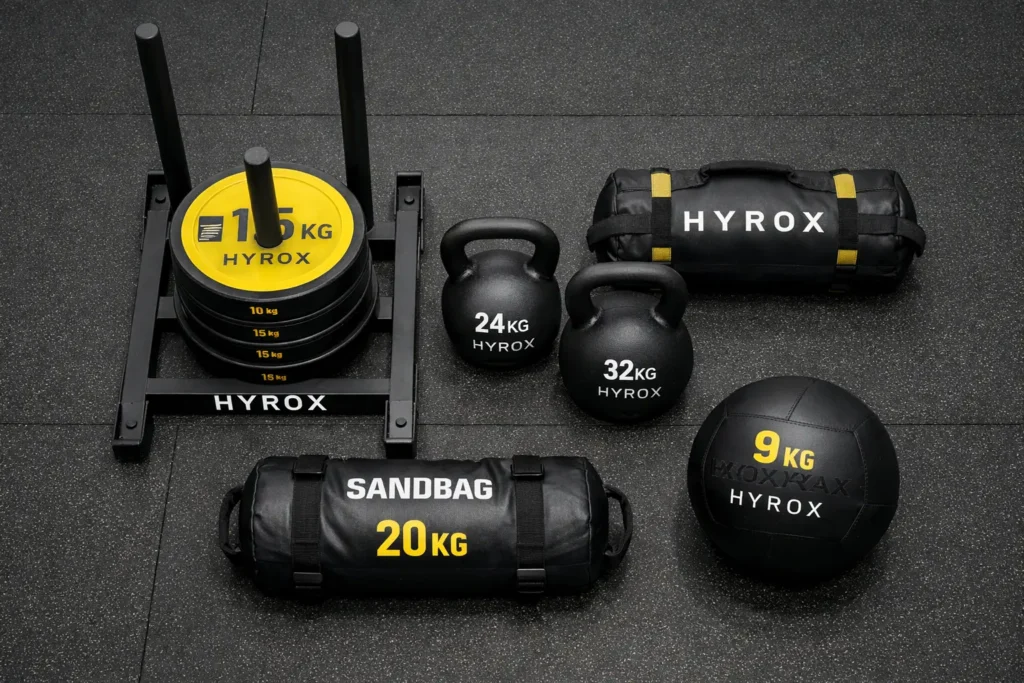
All five weighted stations are demanding, but they do not break athletes in the same way. The load at each station interacts differently with fatigue depending on where it falls in the race order.
The Sled Push (Station 2) hits early, before full fatigue sets in, but the load demands serious leg drive. By Station 7 (Sandbag Lunges), you have already run 7 km and completed six stations, so a weight that felt manageable in training becomes far harder. Station 8 (Wall Balls) is where many athletes mentally collapse: 100 reps when you are completely spent.
- Sled Push (Station 2): the heaviest absolute load, up to 202 kg for Pro Men.
- Sled Pull (Station 3): a lighter load, but grip and posture decide how fast you move it.
- Farmers Carry (Station 6): 200 m of grip and trunk stability under fatigue.
- Sandbag Lunges (Station 7): 100 m on legs that have already run 7 km.
- Wall Balls (Station 8): 100 reps at 4 to 9 kg with nothing left in the tank.
For a full ranking of which stations cost the most time in competition, see our ranking of the hardest HYROX stations.
The Sled Pull is often underestimated. The load is lower than the Sled Push (103 kg vs 152 kg for Open Men), but grip strength becomes the limiting factor, especially in the final third of the race. Train your grip specifically, not just your pulling muscles.
Why HYROX Weights Feel Harder Than in the Gym
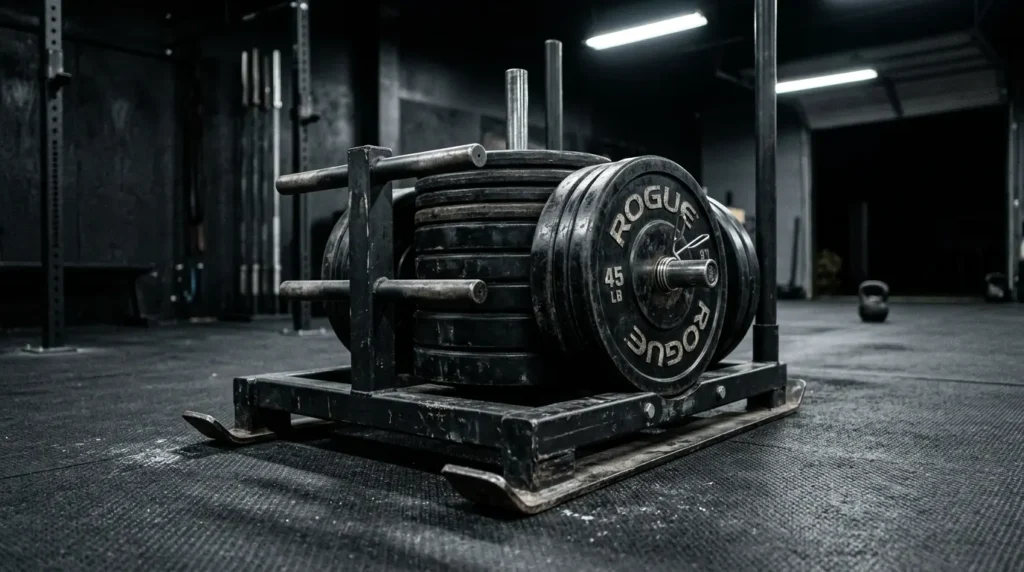
Many athletes train with the correct loads in the gym, then arrive on race day surprised by how heavy everything feels. The cause is almost always the same: they trained strength in isolation.
In HYROX, you never touch a weighted station fresh. Each one comes after a 1 km run at race pace. By the time you reach the Sled Push, your heart rate is already elevated. By the Farmers Carry, your cardiovascular system has been under sustained stress for well over half an hour. The loads do not change, but your capacity to move them does.
This is why general gym fitness does not translate directly to HYROX performance. An athlete who deadlifts double bodyweight can still struggle with 20 kg sandbag lunges if they have never practiced the movement at race pace, under fatigue, after running.
The best way to prepare for HYROX weights is to train them after running, not before. Run 1 km at race pace, then go straight into the weighted station. It is the closest simulation of race conditions you can do in training.
For a complete structure that combines running and station work, the HYROX training guide is the best starting point.
How to Train for Official HYROX Weights
Training effectively for HYROX weights requires three layers working together. Raw strength alone is not enough, and neither is muscular endurance alone. The combination, plus the ability to produce force under cardiovascular fatigue, determines your performance on weighted stations.
Layer 1: build raw strength above race weight. Many athletes and coaches program sled work slightly above official loads, often around 10–20%, so race weight feels controlled on the day. The same logic applies to farmers carry and sandbag lunges. Our guides on training the sled push and pull and training the farmers carry show how to do it.
Layer 2: build muscular endurance at race weight. Volume matters. 100 wall balls sounds simple until you have never done them under fatigue. Athletes who fail here often lack volume exposure, not raw strength, so train the reps, not just the load. See how to train wall balls without destroying your legs.
Layer 3: combine it with running. This is non-negotiable for HYROX-specific preparation. A simple structure: run 1 km at target race pace, go straight into station work, rest, then repeat. This is what converts gym strength into race-day performance.
- Train sled push after hard running intervals, not as a warm-up
- Use rope pulls and loaded carries to build grip endurance for the sled pull
- Practice farmers carry with good posture under race weight for the full 200 m
- Build wall ball volume week by week, do not jump to 100 reps too early
- Include at least one full race simulation per training block
If you want a week-by-week plan, the HYROX training plan for beginners covers running, station work and race simulations in a single programme.
5 Common Mistakes Athletes Make With HYROX Weights

Most race-day failures on weighted stations come from the same predictable errors. Knowing them before your first race saves time and prevents the kind of blow-up that turns a strong athlete into a DNF.
- Training too heavy, too often. Going above official loads every session builds slow, grinding movement patterns that do not match race speed. Use overload sparingly.
- Ignoring grip endurance. The sled pull and farmers carry both punish athletes whose grip fails before their legs do. Add dead hangs, rope pulls and loaded carries to your week.
- Attacking the sled push too aggressively. Station 2 feels manageable early in the race. Athletes who sprint through it often pay on stations 5 through 8. Controlled, consistent drive beats explosion.
- Skipping wall ball volume work. 100 reps at 4, 6 or 9 kg sounds like a conditioning problem, but poor technique wastes enormous energy on failed reps. Train for efficiency, not just capacity.
- Never practicing fatigue-state loading. Training HYROX weights only when fresh is the biggest gap between gym performance and race performance. If you have never done a full station under real cardiovascular fatigue, race day will be the first time.
For a wider view of race-day errors beyond the weighted stations, read where athletes lose the most time in HYROX before your next event.
How to Avoid Penalties on Weighted Stations
Judges check far more than the load on the sled or in your hands. Every weighted station has movement standards that must be met for reps to count, and failing them under fatigue costs time, sometimes more than the station itself.

The most common problems are incomplete range of motion on lunges, wall balls that miss the target, and stations not completed over the full distance. These are technique failures, not strength failures. They happen because athletes are exhausted and never trained the movement standard on purpose.
- Complete the full sled lane distance, do not slow down and stop short
- Cover the full 200 m of the farmers carry with both kettlebells, and if you set them down, pick them up and resume from the same spot
- Hit the wall ball target on every rep and reach full squat depth
- Keep the sandbag on your shoulders and touch the back knee down on each lunge
- Practice these standards with official loads, not lighter versions
For the full penalty system, the HYROX rules and penalties guide explains what judges look for at each station. For official formats and standards, refer to the official HYROX website.
Quick Action Plan — Race-Ready for HYROX Weights
Use this 6-step plan to go from zero to race-ready on every weighted station.
- Identify your division and confirm the exact loads you will face on race day. Do not train blindly.
- Establish your baseline on each station at race weight. How long does it take you fresh? That is your benchmark.
- Build raw strength above race weight for the Sled Push, Sled Pull and Farmers Carry over a 4-week block.
- Add volume for Sandbag Lunges and Wall Balls, working up to race reps across 3–4 weeks.
- Integrate running before every station session, no more training loads when fresh.
- Run a full race simulation 2–3 weeks before race day to confirm you can manage every load under full fatigue.
Want to make sure you have a race to train for? Set up alerts on HYTRACK to be notified the moment tickets go on sale in your region. Events sell out fast, and if one is already full, see these 7 ways to still get into a sold-out HYROX event.
FAQ — HYROX Weights
How heavy is the sled push in HYROX?
The sled push ranges from 102 kg (225 lb) for Women Open to 202 kg (445 lb) for Men Pro. The load includes the sled itself plus added plates. Men Open and Women Pro both push 152 kg (335 lb), so your division determines the exact weight you face.
Do the HYROX weights change between events or countries?
No. The HYROX weights are globally standardized across every event worldwide. A race in London uses the same loads as a race in Houston or Sydney. Standards can change between seasons, so check the official website before entering.
Did the HYROX sled change in 2026?
Yes, HYROX introduced a modified sled with replaceable runners in September 2026. The total loads and the 50 m distance are unchanged, so your training weights stay the same. Lane-to-lane feel can still vary with the surface.
What are the HYROX weights for Doubles?
Doubles use the same loads as singles for your category: Women’s Open Doubles use Women’s Open loads, Men’s Open and Mixed Doubles use Men’s Open loads, and Pro Doubles use the Pro loads for their gender. Partners share the work at each station, but the load itself does not change.
Which HYROX station has the heaviest weight?
The Sled Push carries the heaviest absolute load, up to 202 kg in Men Pro. In practice, many athletes find the Sled Pull just as demanding because grip fails before leg strength does. Both stations deserve specific preparation.
Can beginners handle the HYROX weights in Open?
Yes, with proper preparation. The Open loads are achievable for athletes who have trained for the format. The challenge is managing them after 1 km of running and several previous stations, so 8–12 weeks of specific training before your first race is recommended.
How do I know if I am strong enough for the HYROX weights?
A practical test: complete a 50 m sled push at race weight after running 1 km at your target race pace. If you can do it without breaking form, your strength base is likely sufficient. Repeat the test on the farmers carry and wall balls, and if you struggle, add race-specific work rather than more raw gym volume.
Training tips & HYROX insights
Join the list — guides, race strategies and performance content, straight to your inbox.