

⚡ Quick Answer — HYROX Pro Requirements
Realistically, going HYROX Pro takes 1–3 years of dedicated training, sub-45-minute running fitness, and the ability to move Pro-loaded sleds unbroken. Most athletes underestimate the strength-endurance gap, not the running gap — that’s usually what actually separates Open from Pro.
Every HYROX athlete who’s raced Open at least once has asked the same question at some point during the SkiErg or the second round of burpee broad jumps: could I actually go Pro? The hyrox pro requirements aren’t a secret, but they’re rarely laid out honestly — most content either oversells “anyone can do it” or gatekeeps with vague talk of “elite genetics.” Neither is true. If you want ticket alerts the moment your next race city opens sales, HYTRACK sends instant SMS and email alerts so you’re never scrambling on release day.

Sold-out race? HYTRACK catches cancelled spots.
When athletes cancel, tickets silently reappear — and disappear just as fast. HYTRACK monitors every HYROX event and sends you an instant SMS or email alert the second a spot opens up or new tickets drop.
- Sold-out ticket recovery alerts
- New event on-sale notifications
- SMS & email — real-time
- All HYROX events worldwide
We looked at pacing and station-split data from over 1,200 HYROX Open and Pro finishers to figure out exactly where the gap actually opens up — and it isn’t where most people think. It’s rarely the running. It’s the compartments: sled loads, farmers carry weight, and wall ball reps under fatigue, where Pro’s heavier standards punish anyone who hasn’t specifically trained for them.
×

The first real space for HYROX athletes — race talk, training tips, finding a doubles partner. Free, and growing.
Join on Telegram → Free to join · No app requiredWhat Does It Actually Take to Go Pro in HYROX?
HYROX Pro is a heavier-weight, faster-standard version of the Open division, built for athletes chasing HYROX World Championship qualification. To meet HYROX Pro requirements, you generally need an Open finish time under roughly 65–70 minutes, the strength to move Pro-class sled and farmers carry loads unbroken, and 6+ structured training sessions per week sustained for at least a year.
That said, “Pro” isn’t a certification — it’s a division you self-select into at registration. There’s no test to pass and no gatekeeper checking your times before you sign up (see our breakdown of who can actually compete in HYROX). What matters is whether you can survive the weight jump without your race falling apart mid-run 4.
If you haven’t yet, read our full breakdown of HYROX Divisions Explained (Open vs Pro vs Doubles vs Relay) — it covers the exact rule differences before you register for the wrong one.
Take the Quiz: How Close Are You to HYROX Pro Level?
Six questions, sixty seconds. Answer honestly using your real numbers, not your goal numbers — the whole point is to see the actual gap, not the one you wish you had.
How Close Are You to HYROX Pro Level?
The Real HYROX Pro Standards (Times, Weights & Reps)
Here’s what actually changes between Open and Pro, based on current HYROX rules. Weights and specs get updated periodically, so treat these as a benchmark rather than gospel — always cross-check the current season on the official HYROX rulebook before you commit to a Pro entry.
Pro Division Weights vs Open
The jump from Open to Pro isn’t cosmetic — it’s often 40–60% heavier on the compartments that already break most athletes. For the full, up-to-date table by division, see our HYROX Weights Explained breakdown.
| Station | Open (Men / Women) | Pro (Men / Women) |
|---|---|---|
| Sled Push | 102kg / 82kg | 202kg / 152kg |
| Sled Pull | 78kg / 58kg | 153kg / 103kg |
| Farmers Carry | 2x24kg / 2x16kg | 2x32kg / 2x24kg |
| Wall Ball | 6kg / 4kg | 9kg / 6kg |
For official formats and standards, always refer to the official HYROX website before registering — weights and specs can change between seasons.
Running & Station Time Benchmarks
Running distance and station order stay the same between Open and Pro — what changes is how much the heavier loads slow you down at each transition. If you want exact split targets by division, our HYROX Station Times breakdown and Average Finishing Time benchmarks both cover this in detail.
Pro vs Open: What Actually Changes on Race Day
The running is identical — same 8x1km, same order. What breaks people is compounding fatigue: a heavier sled push at station 1 leaves your legs more cooked going into run 2, which changes your pacing for the rest of the race. This is exactly the kind of gap our Fitness Performance breakdown covers — being generally fit is not the same as being race-fit for heavier loads.
Grip and posterior chain endurance under fatigue is usually the real bottleneck, not raw strength on a fresh set. That’s why athletes who train sled work in isolation, fresh, are often surprised by how much harder it feels after four rounds of running.
Common Mistakes Athletes Make Chasing Pro
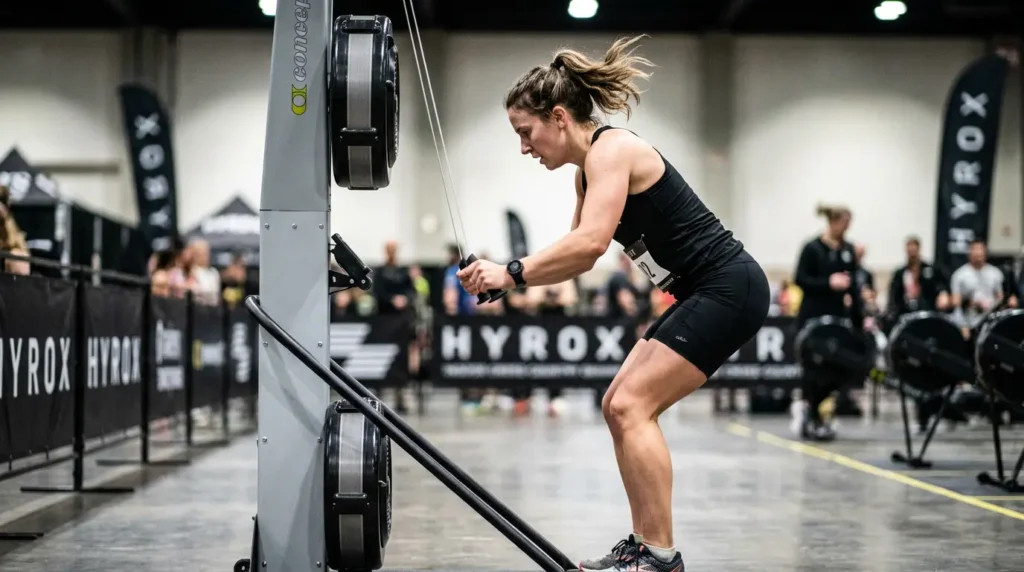
Most athletes who fail their first Pro attempt don’t fail because they’re not strong enough in a vacuum — they fail because they trained the wrong kind of strength.
- Training sled push/pull only when fresh, never after a run block
- Jumping straight to Pro weight without a progressive loading phase — see our sled push and pull training methods
- Ignoring wall ball volume under fatigue, then blowing up at station 8
- Registering for Pro before ever finishing an Open race
- Underestimating the SkiErg — see our SkiErg training guide for Pro-specific pacing
If your quiz score landed in the “6 to 12 months out” range, you’re closer than most people ever get. The gap is specific and trainable — it’s not a talent ceiling.
Quick Action Plan: How to Actually Get There
If your score put you in the “close” or “long-term goal” bracket, here’s a realistic sequence rather than a random collection of workouts.
- Finish at least one Open race before registering for Pro — see our guide to choosing your division
- Progressively load sled push/pull toward Pro weight over 8–12 weeks
- Add fatigued strength work: sled and carries after a hard run, not before
- Build wall ball volume specifically at Pro spec, unbroken sets
- Run a full 8x1km simulation at Open pace with Pro-weight stations
- Track your splits over time using our HYROX Finish Time Estimator
- Follow a structured block — our complete HYROX training plan covers the 8–12 week build
FAQ
How long does it take to go from Open to Pro level?
Most consistent athletes need 1 to 3 years of structured training to comfortably meet HYROX Pro requirements. Athletes coming from a strength sports background often adapt faster to the weight jump; athletes coming from pure endurance backgrounds usually need more time on the sled and carries.
Do I need to qualify to enter HYROX Pro?
No. Pro is a self-selected division at registration, not an invite-only category. Anyone can register for Pro — the real filter is whether you can complete it, not whether you’re allowed to try.
What’s the biggest limiter for most athletes trying to go Pro?
Strength-endurance under fatigue, not raw running speed. Sled push, sled pull, and farmers carry at Pro weight punish athletes who only train these stations fresh.
Should beginners even think about Pro?
Not yet. Build a solid Open finish first — ideally under 90 minutes with good pacing — before shifting your training toward Pro-specific loading.
Are the HYROX Pro weights the same worldwide?
Yes, HYROX standardizes Pro division weights globally across events. For official formats and standards, refer to the official HYROX website, since specs are occasionally updated between seasons.