


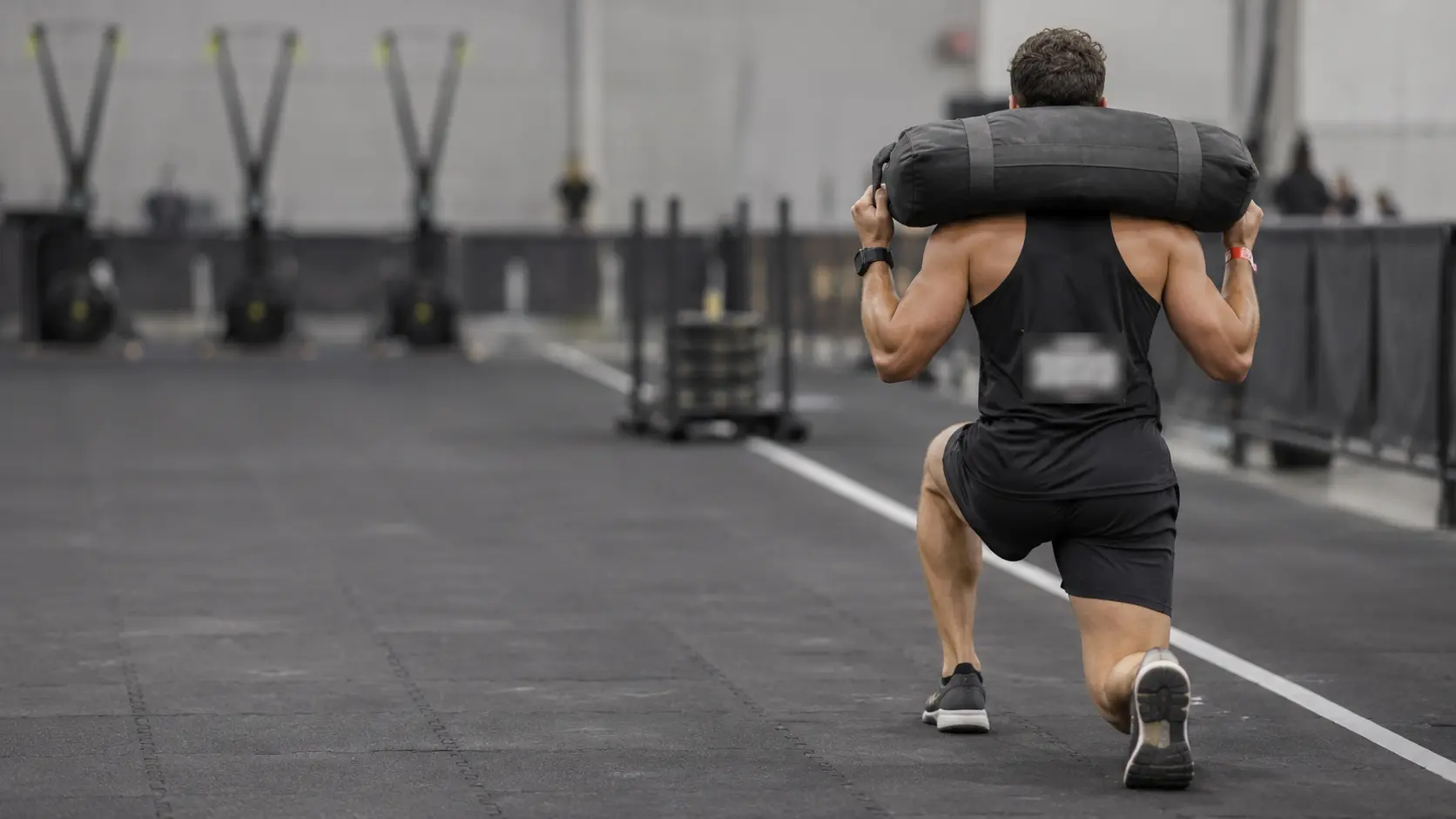
⚡ Quick Answer — HYROX Sandbag Lunges: 7 Proven Tips for Station 7
HYROX sandbag lunges are a 100 m walking-lunge station with a bag of 10 to 30 kg held on both shoulders, and the trailing knee must clearly touch the floor on every rep. It is Station 7 of 8, right after the Farmers Carry and just before the last run and Wall Balls. Short, steady strides and a locked-in bag beat speed.
Everyone says HYROX sandbag lunges “aren’t that hard”, right up until you are on lane three with burning quads and a bag that suddenly weighs twice as much. The station looks simple on paper: walk forward, drop a knee, stand up, repeat for 100 meters.
The difficulty comes from where it sits. You arrive at the lunges after six stations and seven runs, with tired legs and tired forearms, and you still have a run and 100 Wall Balls to go.

Sold-out race? HYTRACK catches cancelled spots.
When athletes cancel, tickets silently reappear — and disappear just as fast. HYTRACK monitors every HYROX event and sends you an instant SMS or email alert the second a spot opens up or new tickets drop.
- Sold-out ticket recovery alerts
- New event on-sale notifications
- SMS & email — real-time
- All HYROX events worldwide
Training for the lunges but still no race to aim at? Open the HYTRACK HYROX ticket alerts page and get an SMS and email the moment tickets drop or a spot reopens on a sold-out event.
We analyzed 3 official HYROX rulebooks (Singles, Doubles and Relay) to pull out the exact lunge standards, weights and penalties. This guide is part of our HYROX training library and turns those rules into a practical plan for Station 7.
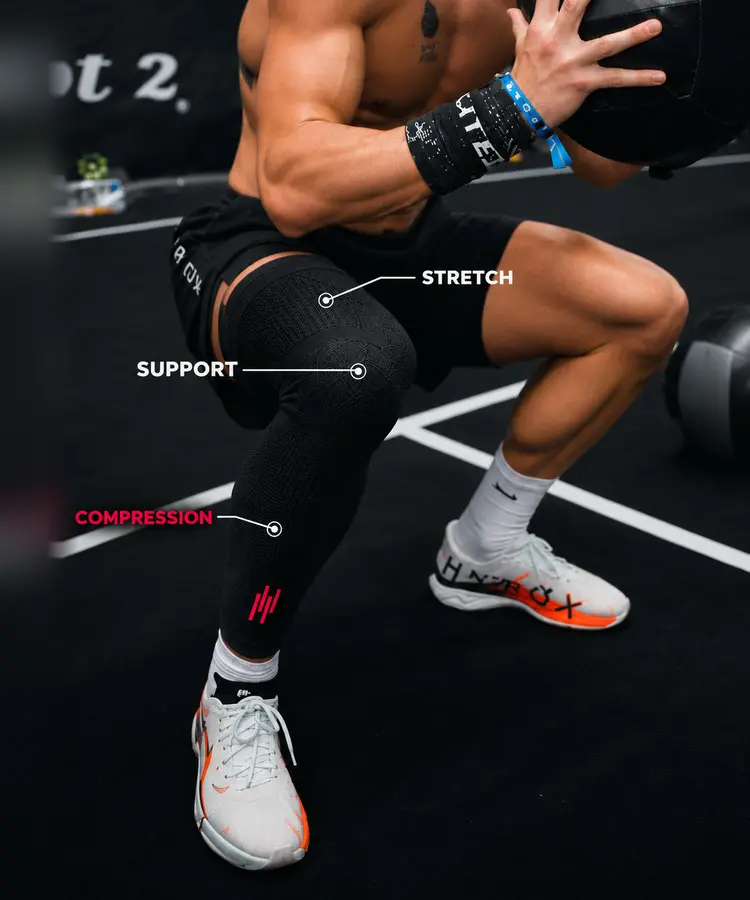
What Are HYROX Sandbag Lunges?
Here is the short definition before we go deeper.
HYROX sandbag lunges are Station 7 of 8: a 100-meter walking lunge carrying a sandbag on both shoulders. The weight is 10, 20 or 30 kg depending on your division. Each rep alternates legs, the trailing knee must clearly touch the ground, and you finish every rep standing tall with knees and hips fully extended.
HYROX sandbag lunges weights by division
Distance stays the same for everyone at 100 meters. For HYROX sandbag lunges, only the bag changes. These loads come from the Singles and Doubles rulebooks, and the Relay rulebook uses 10 kg for women and 20 kg for men.
| Division | Bag weight | Bag color |
|---|---|---|
| Women (Open) | 10 kg | White |
| Women Pro | 20 kg | Grey |
| Men (Open) | 20 kg | Grey |
| Men Pro | 30 kg | Black |
Doubles Mixed follows the 20 kg grey bag. For every other load on the course, see our full guide to HYROX weights by division.
Standards can change between seasons and events. For official formats and standards, refer to the official HYROX website, and check the rulebook for your own division before race day.
HYROX Sandbag Lunges Rules: What Counts as a Valid Rep

We read the full lunge standards in the official HYROX Singles Rulebook, then compared them with the Doubles Rulebook and the Relay Rulebook. The core standards for HYROX sandbag lunges were the same in all three.
- Knee touch: the trailing knee must clearly touch the ground on each lunge.
- Standing tall: every rep ends with knees and hips fully extended.
- Alternating legs: knees must alternate.
- Bag position: the bag stays supported on both shoulders and cannot be set down to rest.
- Lane lines: the front foot must fully cross the white line at the end of each lane and at the finish line.
Does the trailing knee have to touch the floor?
Yes. All three rulebooks require the trailing knee to clearly touch the ground. A hovering knee a few centimeters above the floor is the classic way to collect a penalty. Judges are looking for visible contact, not a hard drop.
Can you rest or take extra steps?
You may lunge continuously or pause with both feet parallel, but the rulebook is strict on one point: “It is not permitted to take any steps or shuffles between repetitions.” Resting with the bag on your shoulders is fine. Dropping the bag or setting it on a barricade is not.
Penalties for sandbag lunge infringements
The Singles penalty table lists 15 seconds per infringement for a trailing knee that does not touch the ground, for not standing tall, and for taking the bag off your shoulders. Not returning the bag to the correct area costs 30 seconds unless you fix it before leaving the Roxzone. The rulebook also describes a formal warning before the first time penalty, so read the exact wording for your event. Our guide to the 12 most common HYROX penalties covers the rest of the course.
Using the wrong bag weight means repeating the whole station with the correct one, and skipping the station is a disqualification. Check the bag color before you pick it up.
Why HYROX Sandbag Lunges Hurt More Than They Look
Ten, twenty or thirty kilos is not heavy in a fresh gym session, yet HYROX sandbag lunges still wreck people. The weight is rarely the problem. The problem is the state of your body when you pick it up.
Where the station sits in the race
The order of the race is fixed. Station 7 comes after the Farmers Carry and before the final 1 km run and the Wall Balls. By then your quads have already been hit by the sled push, the sled pull and burpee broad jumps. This is why the lunges show up on our list of the hardest HYROX stations for so many athletes.
Leg fatigue, grip and balance
Your forearms have just carried two kettlebells for 200 meters, so holding the bag steady with tired hands is harder than it sounds. Single-leg strength also fades fast, and a wobbly stance costs both time and clean reps. If you are still working on the previous station, our guide to the Farmers Carry for HYROX helps you arrive at the lunges in better shape.
HYROX Sandbag Lunges Technique: 7 Proven Tips
Good HYROX sandbag lunges technique is about saving energy on every one of the roughly 100 meters. These seven tips for HYROX sandbag lunges apply to every division.
1. Lock the bag high on both shoulders
The bag has to stay on both shoulders, so set it before you move. Most athletes carry it across the upper back and shoulders, with both hands holding it firmly. A bag that slides forces constant readjustments, and readjusting costs seconds and focus.
2. Choose a stride you can repeat
Long strides look powerful and burn your quads fast. A moderate stride keeps the front shin close to vertical and makes it easier to stand up from every rep. Pick a length you could repeat on fatigued legs, not your best fresh-legs stride.
3. Keep your torso tall
Folding forward under the bag shifts the load onto your lower back and makes standing tall harder, which is itself part of a valid rep. Brace your core, keep your chest up and think “drop straight down, rise straight up”.
4. Touch the knee under control
You need a clear touch, not a crash. Lower yourself until the rear knee lightly meets the floor, then push through the front foot. A controlled touch is easier on the joint and gives judges no reason to doubt the rep.
5. Breathe on a pattern
Your heart rate is already high, and holding your breath under load will make it worse. Try a simple pattern, such as breathing out as you rise and in as you lower. The exact rhythm matters less than having one.
6. Find a tempo you can hold
Rushing the first lane is the most common way to blow up by the third. Move at a pace you could keep for the full distance, then drop the tempo slightly if the burn arrives early. Smooth and steady usually beats fast and broken.
7. Plan your turns and pauses
The course runs in lanes with turning points. You do not need to lunge around the turn, but you must restart each section with both feet behind the white line and lunge across it. Use the turn to reset your posture and breathe, then go again.
Common Mistakes on HYROX Sandbag Lunges
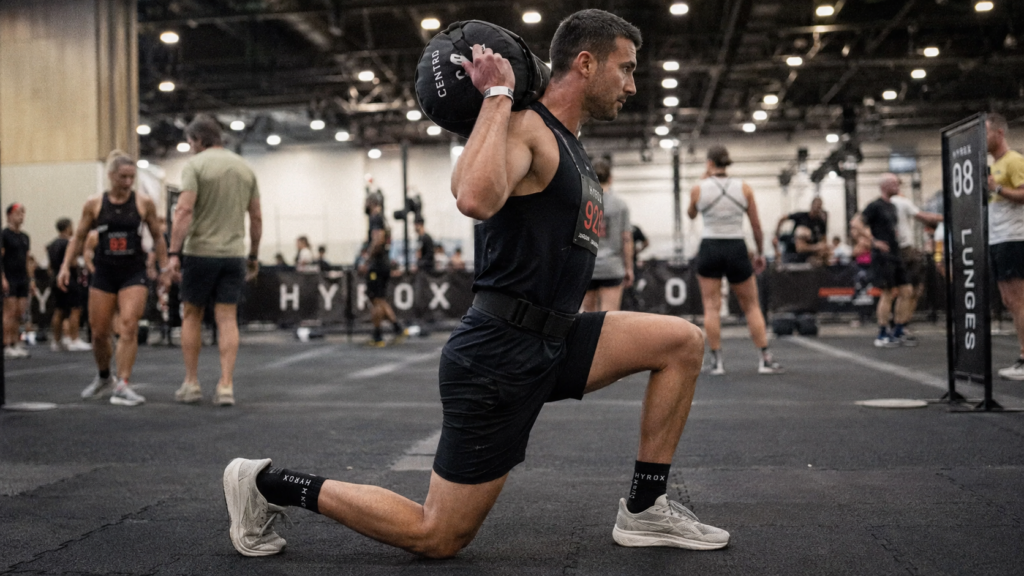
Most time lost on HYROX sandbag lunges comes from a handful of avoidable habits. If you recognise any of these, fix them in training first.
- Going out too fast in the first lane, then slowing down badly.
- Hovering the rear knee instead of touching the ground.
- Taking extra steps or shuffles between reps to find balance.
- Leaning forward and not finishing each rep standing tall.
- Letting the bag slide forward and wasting time readjusting.
- Picking up the wrong bag weight for your division.
For a wider look at where athletes bleed time, read our guide on where most athletes lose time in HYROX.
Pacing Strategy for HYROX Sandbag Lunges
Treat HYROX sandbag lunges as a controlled grind, not a sprint. You are not trying to win the race on this station, you are trying to leave it with enough in the tank for the last run and 100 Wall Balls.
A simple approach is to split the 100 meters mentally into lanes. Settle your rhythm in the first lane, hold it through the middle, and only push in the final stretch if your legs allow it. Brief pauses with both feet parallel are legal, so a short reset in a bad moment can save you from a bigger breakdown. Our HYROX race strategy guide shows how to fit this into your whole plan.
For benchmark times by division, see our HYROX station times breakdown. Times vary a lot with bag weight, fitness and course layout, so use them as a reference rather than a target.
How to Train for HYROX Sandbag Lunges
Training for HYROX sandbag lunges is mostly about practising the movement under fatigue. This is general guidance, not a prescription, so adapt it to your level and any injuries.
- Practice the real standard: alternate legs, touch the knee, stand tall, with a bag or similar load across both shoulders.
- Train after running: lunge when your legs are already tired, because that is how Station 7 feels on race day.
- Build single-leg strength: split squats and step-ups support the lunge pattern.
- Strengthen the upper back and core: they keep the bag stable and your torso tall.
- Rehearse the bag set-up: picking it up, placing it and returning it correctly is part of the station.
Fold these into a structured plan with our complete HYROX training guide, and prepare for the station that follows with our guide to training Wall Balls for HYROX.
What About Your Knees on HYROX Sandbag Lunges?
On HYROX sandbag lunges, the rear knee touching the floor is the part most readers worry about. It is a fair concern: you do it dozens of times, usually on tired legs.
Some athletes wear compression knee sleeves for a supported feel. Padded options cushion impact better, but all three rulebooks list knee sleeves as permitted and do not list padded options, which means they are prohibited unless the Race Director gives written permission before the start. Ask early if you need one.
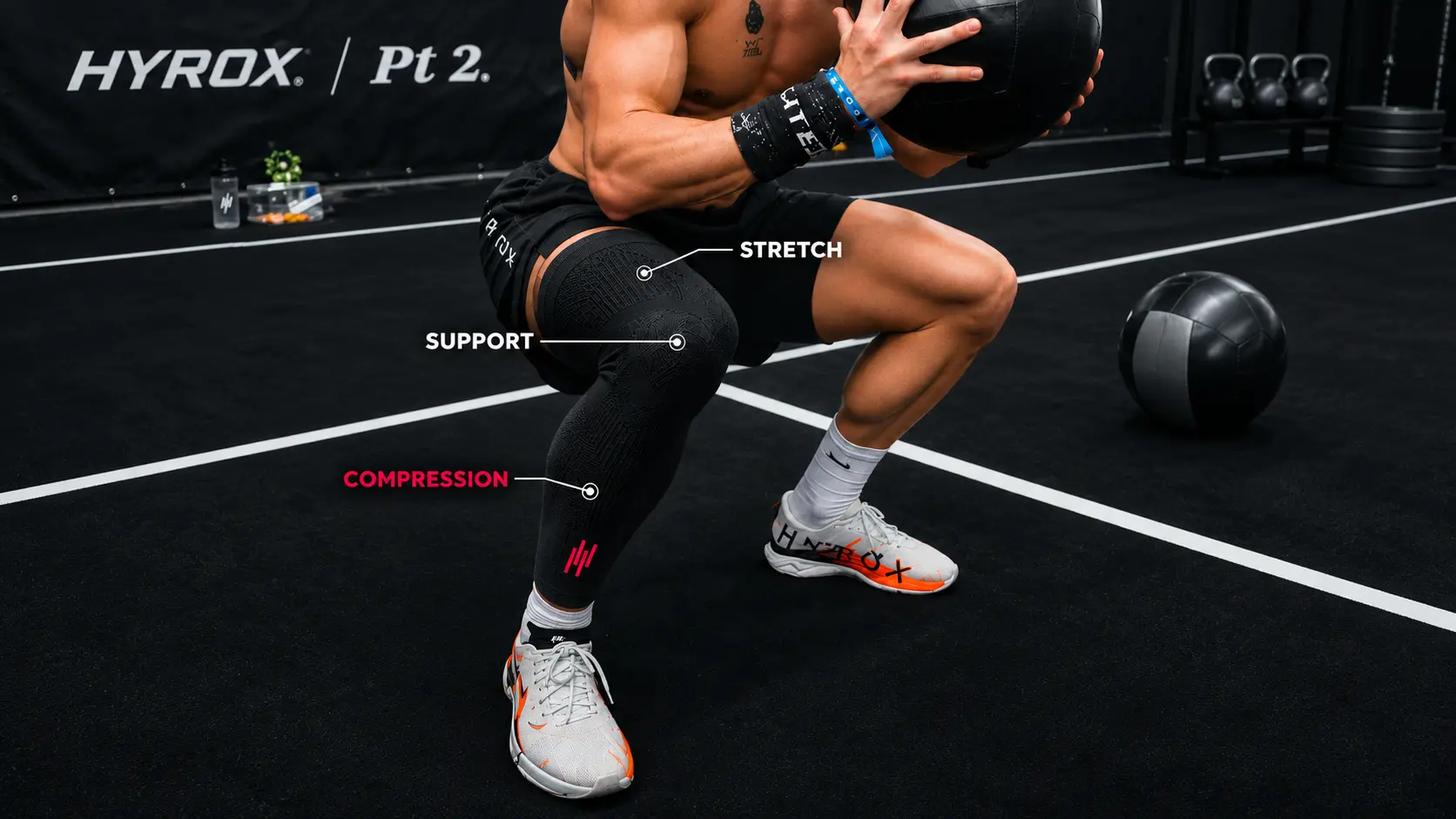
If knee health is a wider concern, our guide to HYROX injury prevention goes further.
Doubles and Relay: How the Lunges Change
For HYROX sandbag lunges in Doubles, both partners enter and leave the station together, and the distance is still 100 meters in total. The resting partner must walk directly behind the working partner, not alongside, and passing the bag must never move it forward. Sideways or backwards is allowed. The Doubles Rulebook also repeats the knee-touch standard and the same penalty structure.
Splitting the work is a strategy decision, so plan it with your partner. Our HYROX Doubles strategy guide covers how to divide stations. In Relay, one athlete handles the station for their leg, using the lighter bag weights listed earlier.
FAQ
How heavy is the bag for HYROX sandbag lunges?
It is 10 kg for Women Open, 20 kg for Women Pro and Men Open, and 30 kg for Men Pro. Doubles uses the same loads, and Relay uses 10 kg for women and 20 kg for men. Always confirm in your own division’s rulebook.
Does the knee have to touch the floor?
Yes, for HYROX sandbag lunges the Singles, Doubles and Relay rulebooks all state that the trailing knee must clearly touch the ground on each lunge. Reps without clear contact can draw a time penalty.
How long do HYROX sandbag lunges take?
HYROX sandbag lunges take a different time for everyone, depending on division, bag weight and fitness, so there is no single number worth chasing. Use our station times guide for reference splits and focus on holding a steady pace.
Is it allowed to rest during the lunges?
During HYROX sandbag lunges you can pause standing with both feet parallel, as long as the bag stays supported on both shoulders and you take no steps or shuffles. You cannot set the bag down on the floor, a barricade or your feet.
Are knee sleeves allowed on this station?
For HYROX sandbag lunges, knee sleeves are on the permitted list in the Singles, Doubles and Relay rulebooks. Padded options are not listed, so they need written permission from the Race Director before the start.
Conclusion: Win Station 7 by Staying Boring
HYROX sandbag lunges reward the athlete who stays calm. Know your bag weight, lock the bag on both shoulders, touch the knee every time and keep a rhythm you can hold. Train HYROX sandbag lunges on tired legs, and you will walk off Station 7 ready for the final run.
Our checks for Singles, Doubles and Relay are based on the official rulebooks linked above. For official formats and standards, refer to the official HYROX website before your race.
Training tips & HYROX insights
Join the list — guides, race strategies and performance content, straight to your inbox.