

⚡ Quick Answer — How to Train Sled Push and Pull for HYROX
Train the sled push and pull for HYROX by combining heavy strength work, technique practice and running fatigue, not by pushing heavy weight in isolation. The push needs quad-dominant leg drive with short, powerful strides, while the pull needs grip endurance and posterior chain strength. No sled? Bulgarian split squats, trap bar deadlifts and rope pulls cover most of the stimulus, and you should finish sled sets with a 200–400 m run.
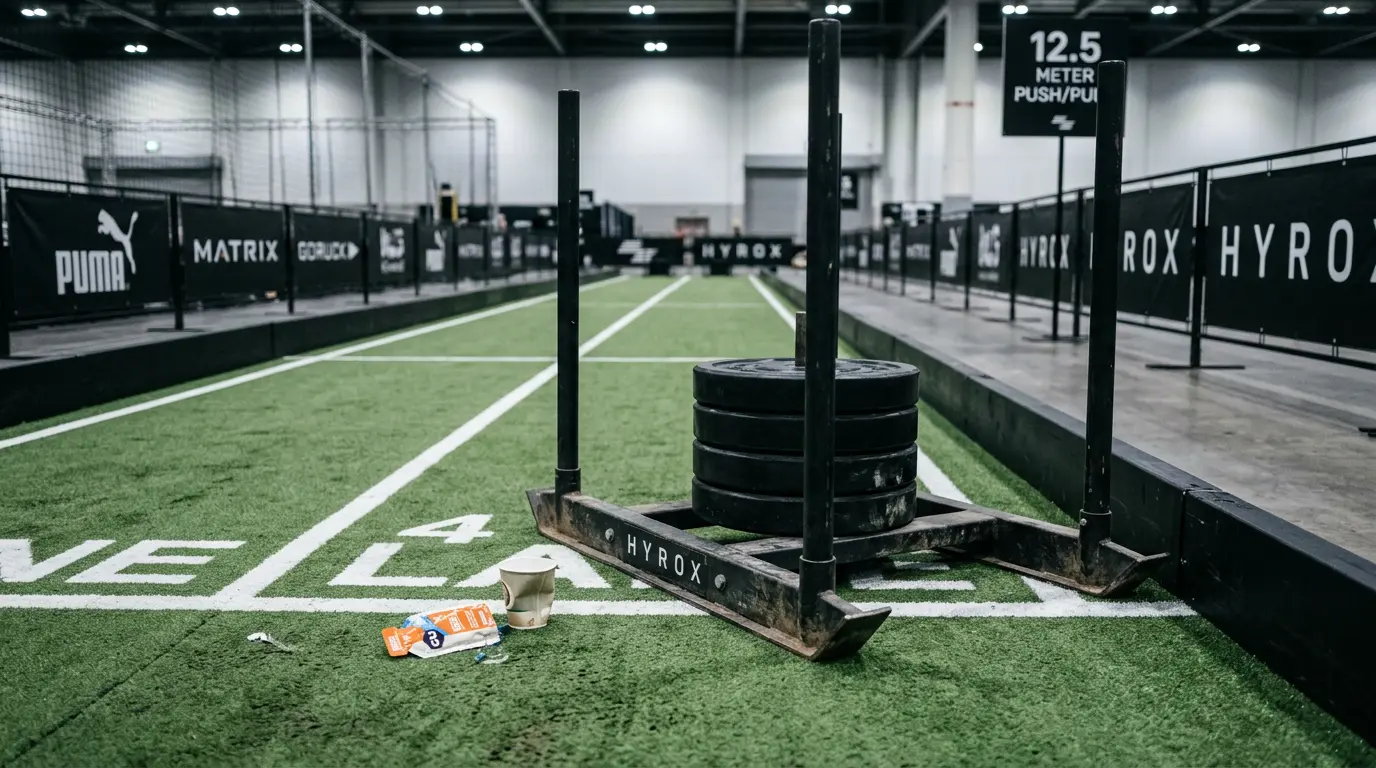
The sled push and pull for HYROX are the stations that separate well-prepared athletes from the rest. Every first-timer underestimates them. The weights on paper look manageable — 152 kg for Men Open and 102 kg for Women Open on the push — but the competition flooring creates friction that can make those numbers feel far heavier than anything you have pushed on a smooth gym floor. Add pre-fatigued legs from a 1 km run, and you have one of the most demanding back-to-back combinations in the race.

Sold-out race? HYTRACK catches cancelled spots.
When athletes cancel, tickets silently reappear — and disappear just as fast. HYTRACK monitors every HYROX event and sends you an instant SMS or email alert the second a spot opens up or new tickets drop.
- Sold-out ticket recovery alerts
- New event on-sale notifications
- SMS & email — real-time
- All HYROX events worldwide
Before you build a sled block, make sure you have a race to train for. The HYTRACK ticket alerts page tells you the moment tickets go on sale or a spot reopens, so you do not miss your event to a sell-out.
×

The first real space for HYROX athletes — race talk, training tips, finding a doubles partner. Free, and growing.
Join on Telegram → Free to join · No app requiredWe analyzed training data and race performance across hundreds of HYROX athletes to build this complete guide to training the sled push and pull for HYROX — covering technique, programming, substitutes, and the transition window that most athletes completely ignore.
Why the Sled Push and Pull for HYROX Are Different From Anything Else You Train
Most athletes approach the sled push and pull for HYROX like a strength exercise. They load up a sled, push it, feel tired, and assume they are prepared. That approach misses the core challenge of these stations entirely.
The HYROX sled push and pull are not pure strength tests. They are fatigue management problems. You arrive at station 2 with an elevated heart rate from your first 1 km run and a SkiErg already behind you. Your quads are warm, your breathing is not fully recovered, and you now need to move 152 kg of sled (Men Open) across 50 meters. The station itself is not the problem — arriving at it unprepared is. That is why training the sled push and pull for HYROX in isolation, without running beforehand, is one of the most common and costly preparation mistakes.
There is also a mechanical reality to respect: a sled that has stopped is harder to get moving again than one that is still rolling slowly. That changes how you approach pacing, stride rhythm and effort management across the full 50 meters. Stopping is never a neutral event — it almost always costs you more than maintaining momentum at a slower pace.
The competition flooring feels very different from the smooth gym floors most athletes train on. If your gym surface is different, adjust your perceived effort rather than chasing an absolute load. The feeling matters more than the number on race day.
Official Standards: Weights, Distance, Rules

Before training the sled push and pull for HYROX, you need to know exactly what you are preparing for. The official standards are fixed worldwide. All sled weights below include the sled itself.
| Station | Division | Sled Weight | Distance |
|---|---|---|---|
| Sled Push | Men Open | 152 kg (335 lb) | 50m (4 × 12.5m) |
| Sled Push | Women Open | 102 kg (225 lb) | 50m (4 × 12.5m) |
| Sled Push | Men Pro | 202 kg (445 lb) | 50m (4 × 12.5m) |
| Sled Push | Women Pro | 152 kg (335 lb) | 50m (4 × 12.5m) |
| Sled Pull | Men Open | 103 kg (227 lb) | 50m (4 × 12.5m) |
| Sled Pull | Women Open | 78 kg (172 lb) | 50m (4 × 12.5m) |
| Sled Pull | Men Pro | 153 kg (337 lb) | 50m (4 × 12.5m) |
| Sled Pull | Women Pro | 103 kg (227 lb) | 50m (4 × 12.5m) |
Both stations cover 50 meters structured as 4 lanes of 12.5 meters, so the sled has to be moved the full distance with a clean turn at each end. For the exact movement standards and penalties, refer to the official HYROX website. If you want to compare these weights across all divisions, our HYROX weights guide covers every station in detail.
2026 Sled Update: Replaceable Runners
In September 2026, HYROX introduced a modified competition sled with replaceable runners, as reported by Hybrid Fitness Media. The goal is more consistent equipment: worn runners can now be swapped without dismantling the sled, which helps keep friction closer to constant as the runners age.
For your training, nothing changes. The loads and the 50 m distance stay exactly the same. Lane-to-lane differences can still exist because the condition of the surface affects friction, so train on more than one surface whenever you can.
Sled Push Technique: The Form Points That Actually Matter
Technique on the sled push and pull for HYROX is not about looking textbook-perfect. It is about generating maximum force efficiently, maintaining momentum across all four 12.5m lanes, and arriving at the sled pull with enough left in the tank to complete it cleanly.
Body Position and Angle
Your torso should be roughly 45 to 60 degrees to the floor — forward enough to generate horizontal force, upright enough to breathe and maintain leg drive across the full 50 meters. Hips should be low and behind the sled handles, not directly above them. If your hips rise above handle height, you lose leverage and your arms start compensating — a fast path to early fatigue on the sled push and pull for HYROX.
Foot Strike and Stride Length
Short, powerful strides generally outperform long strides. Long strides reduce ground contact frequency, create dead spots in your push rhythm, and increase the risk of the sled slowing between steps. Aim for a rapid, choppy cadence — think of driving your feet into the floor rather than reaching forward with each step. This is one of the most impactful technical adjustments most athletes can make when training the sled push for HYROX.
If the sled stops, it costs you more energy to restart it than to maintain slow momentum. Never fully stop — if you feel it slowing, shorten your stride and lower your hips rather than pausing to reset.
Sled Pull Technique: Two Methods and When to Use Each
The sled pull is the more technically complex half of the sled push and pull for HYROX, because athletes have two viable technique options — and choosing the wrong one under fatigue costs significant time and energy.
Hand-Over-Hand
You face the sled, grip the rope, and pull it toward you hand-over-hand while the sled slides across the floor. This method recruits the back, biceps, and forearms heavily, with your legs and core acting as anchors. It is commonly the faster of the two methods when executed well, and many top athletes favor it. The limitation is grip fatigue: hand-over-hand at race pace for 50 meters is genuinely demanding on the forearms, particularly after the SkiErg 1,000 meters earlier. For athletes training the sled push and pull for HYROX seriously, grip endurance is a dedicated training priority, not an afterthought. Our SkiErg training guide shows how to keep the first station from draining your grip.
Backward Walk
You face away from the sled, hold the rope at hip or chest height, and walk backward pulling the sled behind you. This method distributes load more evenly through the posterior chain — glutes, hamstrings, and upper back — and is significantly less demanding on grip. It is usually slower than hand-over-hand but more sustainable under high fatigue. Many Open-division athletes use a hybrid: hand-over-hand for the first lanes while fresh, switching to backward walk when grip degrades.
Train both methods in every sled pull session. Deciding mid-race which technique to use — without having practiced the switch — creates hesitation and costs time. Know exactly at which point of fatigue you will transition from hand-over-hand to backward walk.
The Push-Pull Transition: The Most Overlooked Moment in HYROX
Between the sled push and the sled pull sits a transition window that almost no athlete trains deliberately — and it is one of the highest-leverage improvements available when preparing the sled push and pull for HYROX.
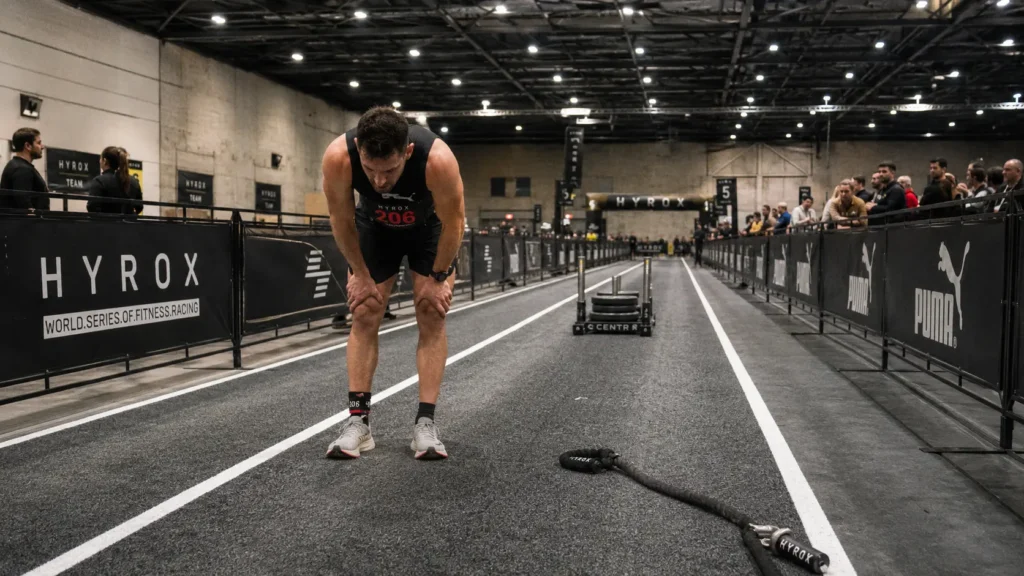
After completing the push, you move to the rope for the pull. Most athletes either rush it — arriving at the rope with a heart rate still spiked from the push — or waste it by moving too slowly. A better approach is a deliberate, controlled walk with active breathing: two full exhales before you grip the rope, and hands shaken out to release forearm tension. A few seconds of controlled recovery at this point can translate into cleaner technique and a steadier pace across the pull.
This transition discipline is exactly the kind of marginal gain that separates athletes with similar fitness levels on the leaderboard. Our article on where most athletes lose time in HYROX covers transition costs in detail.
How to Train Sled Push and Pull for HYROX Without a Sled
Access to a proper weighted sled is the ideal scenario for training the sled push and pull for HYROX — but it is not a prerequisite for arriving race-ready. Much of the strength and movement pattern stimulus can be replicated with equipment available in any commercial gym.
The key is understanding what each station actually demands from your body: the push requires quad-dominant leg drive, core stability, and horizontal force production under load. The pull requires posterior chain strength, grip endurance, and the ability to maintain power output when the forearms are burning. Training those qualities directly — even without a sled — builds the foundation that transfers on race day.
Even if you train all substitutes perfectly, try to get at least 2–3 sessions on an actual sled before race day. The friction of competition flooring and the specific mechanics of the push handles cannot be fully replicated. Surprise on race day is expensive.
7 Best Training Exercises for the Sled Push and Pull for HYROX
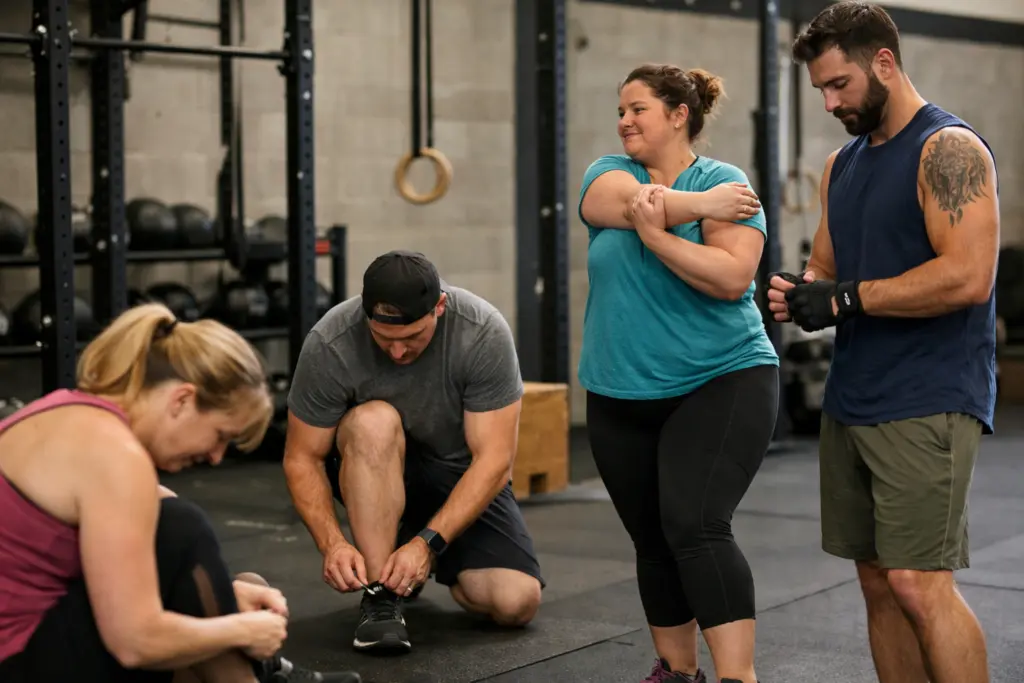
These seven exercises cover the full physical demand of the sled push and pull for HYROX — from raw leg drive to grip endurance to posterior chain strength. Program them across your training week rather than stacking them all in one session.
- Bulgarian Split Squat (weighted). One of the best accessories for sled push leg drive. Builds unilateral quad and glute strength, addresses left-right imbalances, and mirrors the one-leg drive mechanics of the push. 4 sets of 8 per leg, progressive overload across weeks.
- Trap Bar Deadlift. Trains the posterior chain at a forward-lean angle close to the one used in the sled push, and is more specific than a conventional deadlift for this application. 4 sets of 5 at 80–85% of max, focused on explosive drive off the floor.
- Prowler Push (if available). The best direct substitute for the sled push. Mimics the leg drive, body angle, and stride mechanics. Use it for both heavy strength sets and lighter speed intervals.
- Rope Pull / Battle Rope Pulls. Seated or standing rope pulls with heavy resistance simulate the hand-over-hand sled pull mechanics. Build grip endurance by extending set duration rather than adding weight.
- Farmers Carry (heavy). Builds grip endurance and core stability under load — both essential for the sled pull. 4 sets of 40–60 meters, heavier than your race weight. See our farmers carry training guide for progressions.
- Wall Sit with Plate Hold. Trains isometric quad endurance and grip simultaneously. Mimics the sustained tension of the sled push under fatigue. 4 sets of 45–60 seconds.
- Backward Sled Walk / Reverse Drag. Directly trains the backward walk sled pull method. Use a loaded belt or resistance band if no sled is available. 4 sets of 20–30 meters.
Progressive Training Plan: 8 Weeks to Race-Ready Sleds
This 8-week block is designed to build race-ready capacity for the sled push and pull for HYROX progressively — starting with strength foundation and finishing with race-specific fatigue simulation. It assumes 2 dedicated sled sessions per week alongside your running and general HYROX training.
| Phase | Weeks | Focus | Session Structure |
|---|---|---|---|
| Strength Base | 1–2 | Max force + technique | 4×20m push heavy + 4×20m pull — full rest |
| Strength Base | 3–4 | Volume increase | 5×25m push + 5×25m pull — 90s rest |
| Race Specificity | 5–6 | Full distance + run after | 3×50m push + 3×50m pull + 400m run — 2min rest |
| Race Simulation | 7 | Full fatigue simulation | 1km run → 50m push → 50m pull → 1km run × 3 |
| Taper | 8 | Sharpen, reduce volume | 2×50m push + 2×50m pull at race weight — full rest |
The key progression principle: never train the sled stations in isolation during weeks 5 to 8. Always bracket them with running. That is the only way to replicate the specific fatigue state you will face on race day. If you want to understand how these stations fit into a full race preparation block, our complete HYROX training guide covers the full 8–12 week structure.
Common Mistakes at the Sled Stations
Even athletes who have trained hard for the sled push and pull for HYROX fall into the same race-day traps. Knowing these in advance is one of the easiest free improvements available.
- Starting the push too fast. Burning out in the first lane and slowing to a crawl — or stopping — across the final two. The sled push rewards even-effort pacing, not a sprint start.
- Training only with light weight. Athletes who never push close to race weight in training are genuinely shocked on race day. Train at race weight — and above — at least once per week in your final 4 weeks.
- Using only one pull technique. Athletes who only know hand-over-hand have no fallback when grip fails in lane three. Practice both methods in every session.
- Ignoring the transition window. Rushing directly from push to pull without any controlled recovery burns heart rate and grip reserves that you need for the pull.
- Never training with a run beforehand. Isolated sled work does not prepare you for arriving at the station with a high heart rate and pre-fatigued quads. Always add a run before your sled sets from week 5 onwards.
These mistakes are consistent with the broader patterns of performance loss in HYROX. If you are working through your full race preparation, our guide on HYROX running pace covers how to manage the run segments so you arrive at each station with enough capacity to execute cleanly. You can also check our hardest HYROX stations ranked to see where the sled push and pull sit relative to the full race.
Quick Action Plan: 6 Steps to Race-Ready Sled Push and Pull for HYROX
- Know your race weight. Find your division in the table above and build your training loads around it — not around what feels comfortable.
- Train both techniques on the pull. Hand-over-hand and backward walk — practice the transition between them until it is automatic.
- Add a run before every sled session from week 5. At minimum a 400m run at race pace before your first sled set. Ideally a full 1 km.
- Build to full race distance by week 6. 50m push + 50m pull at race weight, bracketed by runs, before your race.
- Practice the transition window. Deliberately move from push to pull with controlled breathing in every session.
- Get at least 2–3 sessions on a real sled and competition-style flooring. The friction difference is real and needs to be experienced before race day — not on it.
Want to make sure there is a start line waiting for you? Set up alerts on HYTRACK to be notified the moment tickets go on sale. Events sell out fast, and if yours is already full, here are 7 ways to still get into a sold-out HYROX event.
FAQ — Sled Push and Pull for HYROX
How heavy is the sled push and pull for HYROX?
In the Open division, the push is 152 kg for men and 102 kg for women, and the pull is 103 kg for men and 78 kg for women. In Pro, the push is 202 kg for men and 152 kg for women, and the pull is 153 kg for men and 103 kg for women. All weights include the sled, and both stations cover 50 meters in 4 lanes of 12.5 meters.
Can I train the sled push and pull for HYROX without a sled?
Yes. Bulgarian split squats, trap bar deadlifts, prowler pushes, rope pulls, and farmers carries cover much of the training stimulus. However, aim to get 2–3 sessions on an actual sled before race day — the friction of competition flooring cannot be fully replicated by gym substitutes, and the surprise on race day is costly.
What is the best technique for the HYROX sled pull?
Hand-over-hand is usually faster when grip is fresh. Backward walk is more sustainable under fatigue. Many Open athletes use hand-over-hand early and transition to backward walk when grip degrades. Training both methods and knowing exactly when to switch is the most important technical skill for the sled push and pull for HYROX.
Why does the sled feel so much heavier at HYROX than in training?
Competition flooring can create noticeably more friction than the smooth floors found in most gyms, so the same load often feels heavier. On top of that, you arrive at the station already fatigued from a 1 km run. Both factors compound. Training on similar surfaces and always bracketing sled work with runs is the best way to close that gap.
How often should I train the sled push and pull for HYROX?
Two dedicated sled sessions per week is a solid target during the 8 weeks before your race. One session focused on heavy strength (above race weight, full rest between sets) and one focused on race simulation (race weight, bracketed by runs, shorter rest). More than two sled sessions per week can create too much leg fatigue to maintain running quality.
What muscles does the HYROX sled push train?
The sled push primarily targets the quadriceps, glutes, and hip flexors — with significant demand on the core for stability and the upper back and shoulders for maintaining the push angle. The sled pull shifts the emphasis to the posterior chain — hamstrings, glutes, lats, and biceps — with the forearms and grip under heavy sustained load. For official formats and standards, refer to the official HYROX website.
Training tips & HYROX insights
Join the list — guides, race strategies and performance content, straight to your inbox.