

Most athletes finish a HYROX race and only look at one number: the total time. That’s a mistake. Your overall finish hides everything — where you were strong, where you lost minutes, and exactly what needs to improve before your next race.
Understanding your HYROX station times is how you train smarter, not just harder. When you know what average splits look like at your division level, you can set realistic targets, spot your weakest link, and stop wasting time fixing things that weren’t even broken.
This guide breaks down average HYROX station times for all 8 exercises — with benchmarks for Open, Pro, and Doubles divisions — so you have a real number to aim at, not just a guess.
What Are HYROX Station Times and Why Do They Matter?
Your HYROX station times are the individual split times recorded for each of the 8 functional exercises during your race — not your training times, but your actual performance under fatigue, right after a 1km run. Every HYROX event captures these via timing chip and publishes them in full on the official results page after race day.
Most athletes stop at the total finish time. The ones who improve fastest go deeper. Your HYROX station times tell you three critical things: where your fitness is holding up, where fatigue is exposing a weakness, and whether your pacing strategy is costing you time at the wrong moment.
If you’ve never compared your splits to division averages, you’re training blind. These benchmarks are your map.
Average HYROX Station Times at a Glance (Open Division)
The table below shows estimated average HYROX station times for the Open division, based on data from major HYROX events. Use these as a starting point — your times will vary based on running fitness, strength level, and race-day floor conditions.
| Station | Distance / Reps | Men Open (avg) | Women Open (avg) |
|---|---|---|---|
| 1 – Ski Erg | 1,000m | ~4:20 | ~5:05 |
| 2 – Sled Push | 50m | ~2:40 | ~2:35 |
| 3 – Sled Pull | 50m | ~2:50 | ~2:50 |
| 4 – Burpee Broad Jumps | 80m | ~5:00 | ~5:30 |
| 5 – Row Erg | 1,000m | ~4:45 | ~5:05 |
| 6 – Farmers Carry | 200m | ~2:20 | ~2:25 |
| 7 – Sandbag Lunges | 100m | ~4:30 | ~5:00 |
| 8 – Wall Balls | 100 reps | ~6:00 | ~7:00 |
HYROX station times shown are approximate averages based on available race data. For official split data by event and division, refer to the official HYROX website.
HYROX Station Times by Division

Open Division
In the Open division, athletes complete all 8 stations solo with moderate weights. Combined HYROX station times across all 8 exercises typically sit between 32 and 40 minutes for most Open finishers, with running adding another 42 to 50 minutes on top. That puts the majority of the field between 1:15 and 1:40 total.
If you want to understand the exact weights before comparing your HYROX station times to these averages, this full breakdown of HYROX weights by division covers every station load across Open, Pro, and Doubles.
Pro Division
Pro athletes carry significantly heavier loads — particularly on the Sled Push, which jumps to 202kg for men and 152kg for women versus 152kg and 102kg in Open. This is why Pro Sled Push times are often longer than Open, despite Pro athletes being fitter overall. For most other stations, the difference in HYROX station times between Pro and Open is around 10 to 20 seconds.
Doubles Division
In Doubles, partners split stations in a You Go / I Go format — each athlete completes roughly half the reps per station. This naturally brings individual HYROX station times down. A Doubles Ski Erg averages around 3:50–4:10 for mixed teams versus 4:20 for a Men Open individual. However, transitions and communication overhead erase some of those gains. The full HYROX divisions guide covers formats in detail if you’re still deciding which is right for you.
Station-by-Station Breakdown: Times, Tips, and What to Watch
Station 1 – Ski Erg (1,000m)

The Ski Erg opens your race with legs still relatively fresh — and it’s one of the most commonly paced wrong. Athletes who push hard here pay for it on runs 3 and 4.
Average HYROX station times — Ski Erg: Men Open ~4:20 | Women Open ~5:05 | Men Pro ~4:10 | Women Pro ~4:47
The gap between Elite and Average athletes on the Ski Erg is actually the smallest of any station. Raw Ski Erg fitness doesn’t separate good from great HYROX athletes — pacing does. Sub-4:30 for men and sub-5:10 for women is a solid Open target. Stay tall, pull from the lats, and resist the urge to sprint the first 200 meters.
Station 2 – Sled Push (50m)

The Sled Push is where race reality hits. Floor surface at your venue matters enormously — rough rubberized flooring can add 30 to 60 seconds compared to a smooth surface, making cross-event comparisons unreliable.
Average HYROX station times — Sled Push: Men Open ~2:40 | Women Open ~2:35 | Men Pro ~3:10 (202kg) | Women Pro ~3:15 (152kg)
Men’s and Women’s Open times are very close here — technique matters more than raw strength. Keep hips high, arms straight, and drive from the legs. Athletes who drop their hips lose all forward force and easily add 20 to 40 seconds.
Station 3 – Sled Pull (50m)

Walking backward with a rope while pulling a heavy sled is harder to pace than it looks. Grip fatigue and coordination break down quickly if you go out too fast.
Average HYROX station times — Sled Pull: Men Open ~2:50 | Women Open ~2:50
Men’s and Women’s Open times are nearly identical on the Sled Pull. Most athletes underestimate it in training — the last 5 meters when grip gives out can cost 30 to 45 seconds alone. Train your grip specifically and practice the backward walk pattern at race weight.
Station 4 – Burpee Broad Jumps (80m)

Burpee Broad Jumps are where beginners lose the most time relative to experienced athletes. It’s 80 meters of ground-to-jump reps, and rhythm is everything — break the pattern once and it’s hard to restart.
Average HYROX station times — Burpee Broad Jumps: Men Open ~5:00 | Women Open ~5:30
The time gap between Elite and Average on Burpee Broad Jumps is one of the largest of any station. Elites use a consistent jump distance and breathing pattern from rep one to the last. Average athletes slow their landing recovery, shorten their jumps, and end up taking significantly more steps per meter. Train the pattern specifically — not just the fitness behind it.
Station 5 – Row Erg (1,000m)

Row Erg arrives at the halfway point when fatigue is already meaningful. Most athletes arrive with burning legs and heavy arms — and then sprint the first 200 meters of the row anyway.
Average HYROX station times — Row Erg: Men Open ~4:45 | Women Open ~5:05 | Men Pro ~4:26 | Women Pro ~4:59
Target a steady stroke rate of 22 to 26 spm and aim for consistent 500m splits throughout. For most Open athletes, 2:15–2:25 per 500m is realistic and sustainable under race conditions. Resist the urge to sprint — the debt always comes due on the next 1km run.
Station 6 – Farmers Carry (200m)

200 meters with heavy kettlebells sounds short. After your grip has already been taxed by sled pulls and several runs, it’s a different challenge entirely.
Average HYROX station times — Farmers Carry: Men Open ~2:20 | Women Open ~2:25
The Farmers Carry is one of the quickest stations by time, but it hammers grip and posture. Walk fast, keep shoulders packed back, and don’t set the kettlebells down — every stop costs 10 to 15 seconds of momentum and a mental reset you can’t afford this late in the race.
Station 7 – Sandbag Lunges (100m)

Front-rack sandbag lunges over 100 meters at Station 7 is a quad destroyer. Your legs have already absorbed 7 runs and 6 stations — and Wall Balls are waiting on the other side.
Average HYROX station times — Sandbag Lunges: Men Open ~4:30 | Women Open ~5:00
Step length is critical. Short, choppy lunges mean more total reps and more time. Drive through the heel, extend your stride, and find a breathing rhythm. Athletes who break into too many rest stops easily add 1 to 2 minutes compared to someone with equivalent fitness who paced it right.
Station 8 – Wall Balls (100 reps)

Wall Balls close every HYROX race. 100 reps to a 3-meter target, on dead legs, when your lungs are already burning. This is where races are won or lost for most Open athletes.
Average HYROX station times — Wall Balls: Men Open ~6:00 | Women Open ~7:00
The range on Wall Balls is enormous — under 5 minutes for strong athletes, over 10 minutes for beginners who hit failure and are forced into long breaks. The fix: break it into planned sets before you’re forced to. A common structure is 20-15-15-15-15-10-10. Never go to failure on a set — the recovery cost is too high this late in the race.
Wall Balls is consistently one of the most punishing stations for Open athletes. For a full comparison of which stations are hardest overall and why, this ranking of HYROX stations by difficulty breaks it all down.
Running Splits: The Other Half of Your HYROX Time
HYROX station times only tell half the story. Running accounts for roughly 45 to 55% of your total finish time — 8 separate 1km segments that progressively get harder as station fatigue accumulates with each lap.
Average total running time (Open): Men ~42:00–44:00 | Women ~47:00–50:00
That works out to approximately 5:15–5:30 per km for men and 5:50–6:15 per km for women in Open — noticeably slower than a fresh 5K pace, because the stations eat into your legs with every lap. A useful rule: if your standalone 5K pace is 5:00/km, budget 5:30–5:45/km per km in a HYROX. The final two laps are always slower than the first two, regardless of fitness.
For a full strategy on building your running pace without sacrificing station strength, this guide on training running for HYROX covers exactly that balance.
Where Most Athletes Lose the Most Time
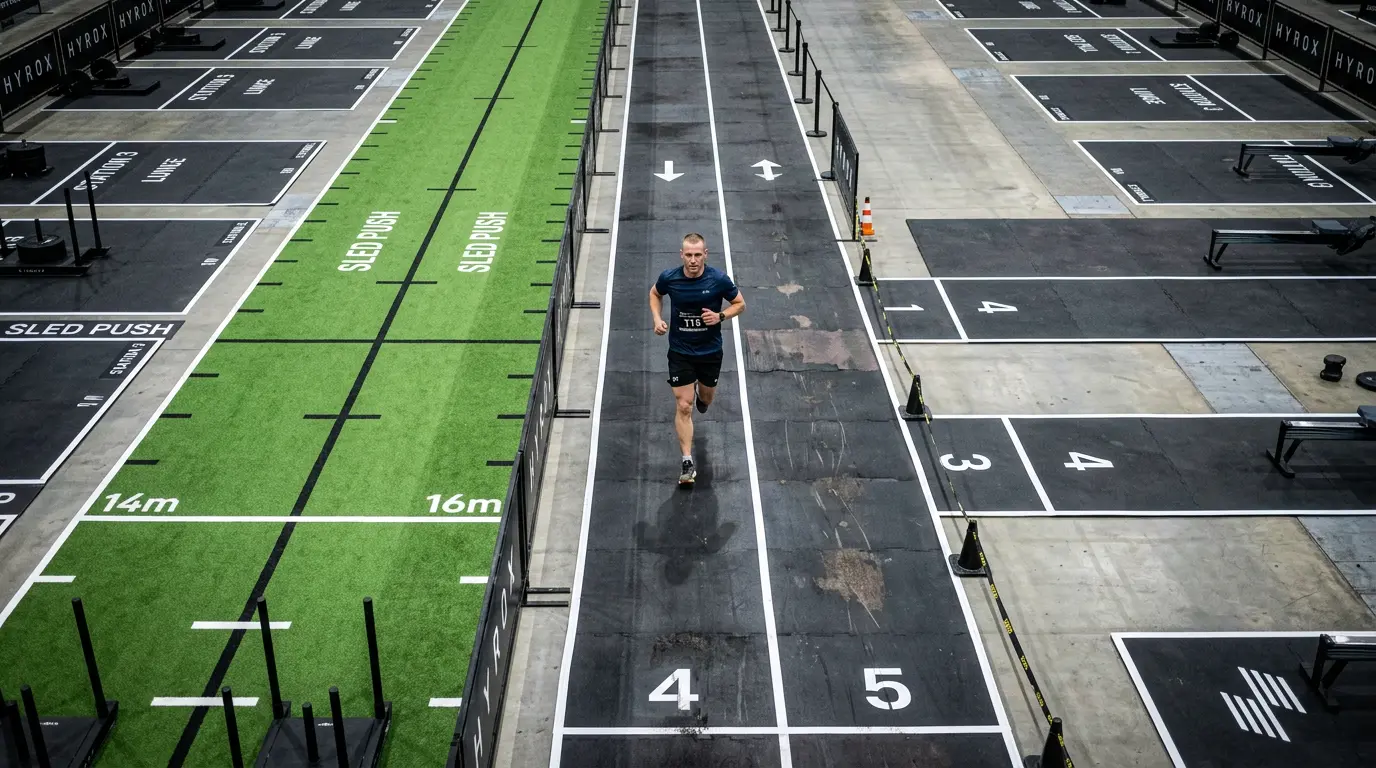
Knowing your target HYROX station times is only useful if you can identify where you’re currently bleeding minutes. Most athletes lose time in the same predictable places — and most of it is recoverable.
- Sled Push and Pull technique errors — wrong hip position or grip angle adds minutes that no amount of extra fitness can compensate for
- Burpee Broad Jump rhythm breaks — losing the movement pattern costs 30 to 90 seconds versus a consistent, controlled pace
- Wall Balls to failure — going unbroken too long on early sets forces long involuntary breaks at the worst possible moment
- RoxZone transitions — the transition area between running track and stations costs 5 to 12 minutes total for most Open athletes, almost entirely recoverable with deliberate practice
- Starting the Ski Erg too hard — the most common pacing error in HYROX, and one that compounds across every station that follows
For a full breakdown of the biggest race killers, this guide to where HYROX athletes lose the most time goes deep on every major pattern.
And to see how your total time compares to others in your age group and division, the HYROX average time by age group guide gives you the full picture across the field.
Quick Action Plan: How to Use These HYROX Station Benchmarks
Benchmarks are only useful when you act on them. Here’s how to turn these HYROX station times into a concrete training advantage before your next race.
- Pull your last race splits from the official HYROX results page — every individual station time is recorded and published there.
- Compare each of your HYROX station times to the Open averages in this guide. Any station more than 60 seconds over average is an immediate training priority.
- Identify your 2 slowest stations relative to benchmark — these are where your biggest time gains are hiding, not your strongest stations.
- Set a target time for each station for your next race. Aim to close the gap by 15–20% per race, not 50% overnight.
- Check your running pace per km against the benchmarks above — running is typically the highest-leverage improvement for total finish time.
- Practice RoxZone transitions. Treat transition time as a station in itself — it’s often 5 to 12 minutes of near-free speed waiting to be recovered.
- Track your station splits across multiple races. Your personal trend over 2 to 3 events is far more informative than any single result.
Ready to put these benchmarks to the test? HYROX events sell out fast — often within hours of opening. To make sure you don’t miss ticket sales for your next race, set up a HYTRACK alert and be the first to know the moment registration opens.
FAQ
What is a good HYROX station time for a beginner?
For a first race in the Open division, aim for under 5:00 on Ski Erg and Row Erg, under 3:00 on Sled Push and Pull, and under 8:00 on Wall Balls. More importantly: complete all stations without stopping. That discipline matters more than any individual split at your first race — your times will naturally drop as you understand pacing.
Why are my HYROX station times slower than in training?
Two main reasons: accumulated fatigue from running between stations, and floor surface. Race venues often use rough rubberized or carpet-over-concrete flooring that creates significantly more resistance than a smooth gym surface — especially on the Sled Push, where it can add 30 to 60 seconds alone. Always plan with conservative estimates based on race conditions, not gym conditions.
Which HYROX station takes the longest on average?
Wall Balls consistently produces the longest HYROX station times for most Open athletes — averaging 6 to 7 minutes, and significantly more for beginners who break into forced rest sets. Ski Erg, Row Erg, and Burpee Broad Jumps follow closely, each averaging 4:30 to 5:30 depending on gender and division. Sled Push, Sled Pull, and Farmers Carry are the shortest stations by time.
How do Pro division station times compare to Open?
For most stations, the difference in HYROX station times between Pro and Open is smaller than expected — around 10 to 20 seconds. The exception is the Sled Push, where the heavier weight in Pro (202kg for men vs 152kg in Open) makes Pro times noticeably longer despite overall better fitness. The real Pro advantage shows up in running — roughly 3 to 5 minutes faster over the full 8km.
Can I use my training times as a race benchmark?
Use gym times as a reference, but expect race HYROX station times to run 10 to 20% slower. The cumulative fatigue from running between stations creates a kind of tiredness that training sessions rarely replicate. Plan conservatively — you can always go faster than your target, but you can’t undo a blown pacing strategy mid-race.
Where can I find my official HYROX station times after a race?
Your full split data is published on the official HYROX website after every event. Navigate to the Rankings section, find your race, and search by name or bib number. You’ll see every individual station time and running lap, plus your ranking within your division. This is the most useful post-race training tool available — and most athletes never use it.
For official race formats and station standards, refer to the official HYROX website.
Training tips & HYROX insights
Join the list — guides, race strategies and performance content, straight to your inbox.