

If you’re preparing for a race, understanding the HYROX weights is one of the most important parts of your training. Every HYROX event includes eight workout stations, and several of them involve moving or lifting significant loads.
Athletes frequently underestimate how heavy the sled push, sled pull, or farmers carry actually feel during the race. The official HYROX weights vary depending on the division you compete in, such as Open, Pro, Doubles, or Relay.
This guide breaks down the exact HYROX weights used in competition, explains how they differ between divisions, and shows how elite athletes prepare for these loads. You’ll also learn which stations feel the heaviest and how to train effectively for them.
Quick Answer: What Are the Official HYROX Weights?
The official HYROX weights depend on the race division, but the heaviest stations typically include the sled push, sled pull, farmers carry, and wall balls.
- ✅ Sled Push: up to 202 kg (Pro Men)
- ✅ Sled Pull: up to 153 kg (Pro Men)
- ✅ Farmers Carry: up to 32 kg kettlebells
- ✅ Sandbag Lunges: up to 30 kg
- ❌ SkiErg and Rowing: bodyweight endurance, no external load
These loads are standardized across HYROX competitions worldwide but vary depending on division.
All HYROX Weights by Division
The HYROX weights change depending on whether you compete in Open, Pro, Doubles, or Relay divisions. The Pro division uses the heaviest loads, while Relay distributes the workload between four athletes.
Knowing these differences helps athletes choose the right division and prepare properly during training.
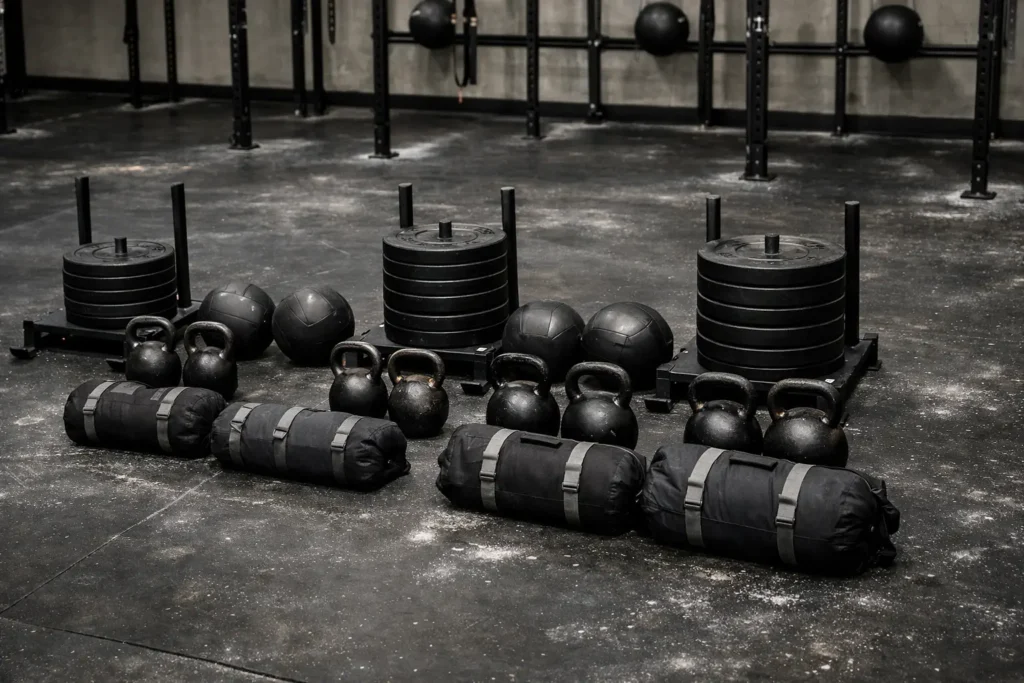
| Station | Open Men | Open Women | Pro Men | Pro Women |
|---|---|---|---|---|
| Sled Push | 152 kg | 102 kg | 202 kg | 152 kg |
| Sled Pull | 103 kg | 78 kg | 153 kg | 103 kg |
| Farmers Carry | 24 kg | 16 kg | 32 kg | 24 kg |
| Sandbag Lunges | 20 kg | 10 kg | 30 kg | 20 kg |
| Wall Balls | 6 kg | 4 kg | 9 kg | 6 kg |
These official HYROX weights are designed to challenge both strength and endurance simultaneously, which is what makes the race unique.
The Stations That Feel the Heaviest
Even though the listed HYROX weights are fixed, some stations feel significantly harder than others once fatigue accumulates during the race.
The sled push is widely considered the most brutal station because athletes must generate force while already fatigued from running and previous exercises.
The sled pull is another station where the weight feels heavier than expected because grip strength becomes the limiting factor.

Why HYROX Weights Feel Harder Than the Gym
Many athletes train with the correct HYROX weights in the gym but still struggle during competition. The main reason is fatigue.
During a HYROX race, each workout station comes after a one-kilometer run. By the time you reach the heavier stations, your heart rate is elevated and your legs are already fatigued.
This combination of endurance and strength is what separates HYROX from traditional gym workouts.
Our HYROX training guide explains how to simulate these conditions during workouts.
What Officials Actually Check During the Race
Officials do not only check the HYROX weights. They also verify that athletes complete each movement correctly.
- Sled must cross the full lane distance
- Farmers carry kettlebells must not touch the floor
- Wall balls must hit the correct target height
- Sandbag lunges must be completed with full extension
Understanding these rules prevents penalties and unnecessary time loss.
You can check official race standards on the HYROX official website.
Common Mistakes Athletes Make With HYROX Weights
Many competitors fail their first race because they misunderstand how the HYROX weights affect pacing.
- Starting the sled push too aggressively
- Ignoring grip endurance for the sled pull
- Using kettlebells heavier than race weight during training
- Neglecting technique on wall balls
If you are new to the race format, the HYROX beginner guide explains how to prepare for these stations effectively.
How Elite Athletes Train for HYROX Weights
Elite athletes do not simply lift the official HYROX weights. They train with slightly heavier loads to build resilience.
For example, sled pushes are often trained with 10–20% more weight than the race standard. This makes the competition load feel manageable.
They also practice race simulations where strength exercises follow running intervals. This mimics real HYROX fatigue.
For equipment recommendations, see our HYROX gear guide.
HYROX Weights by Division: Open vs Pro vs Doubles vs Relay
One of the most common mistakes athletes make is assuming that HYROX weights are identical across every race format. They are not. While the race structure stays largely the same, the actual loads and the way the work is distributed depend on the division you enter.
The biggest jump happens between Open and Pro. In Pro, the sled push, sled pull, farmers carry, sandbag lunges, and wall balls all become noticeably heavier. That means athletes who can survive Open comfortably may still struggle badly in Pro if they have not trained specifically for those standards.
Doubles changes the challenge in a different way. The HYROX weights are usually aligned with the Open category, but athletes can share the functional stations. This lowers the muscular demand per athlete, but it does not remove the need for race-specific strength. Relay reduces the workload even more because each athlete only completes two stations and two runs, which makes heavy stations more manageable.
| Division | Weight Demand | Main Difficulty | Best For |
|---|---|---|---|
| Open | Moderate | Balanced endurance and strength | Beginners and first-time racers |
| Pro | High | Much heavier sleds and carries | Experienced athletes |
| Doubles | Moderate | Shared station workload | Athletes wanting team strategy |
| Relay | Lower per athlete | Shorter workload segments | Newcomers and mixed teams |
If you are still deciding which race format fits your current level, our HYROX events guide can help you understand how each division works in practice. Choosing the right division matters because the official HYROX weights are a major part of the race difficulty.
How to Train for Official HYROX Weights
Training for HYROX weights is not just about lifting heavier in the gym. The real challenge is producing force while tired. In competition, no weighted station happens when you are fresh. Every major load comes after running, elevated heart rate, and mounting muscular fatigue. That is why general strength training is useful, but not enough on its own.

A practical training plan should include three layers. First, build raw strength with sled pushes, sled pulls, loaded carries, lunges, and squat-based work. Second, improve muscular endurance by doing longer sets and race-style volume. Third, combine those movements with running so that the official HYROX weights feel familiar under fatigue.
- Train sled push after hard running intervals
- Use heavy rope pulls to build sled pull grip endurance
- Practice farmers carry with race weight and controlled posture
- Build wall ball volume gradually instead of doing random burnout sets
- Run before weighted stations to simulate race fatigue
Athletes often make the mistake of training too heavy, too early. That creates slow movement patterns and does not always transfer well to race speed. A better approach is to spend most of your time close to official HYROX weights, then occasionally go slightly above them to build confidence. The goal is not just to survive the load. The goal is to move efficiently at race pace.
If you want a broader weekly structure, the HYROX training guide is the right next step. It helps connect strength work, running, and station practice into a complete preparation strategy.
How to Avoid Penalties on Weighted HYROX Stations
Athletes usually focus on the HYROX weights themselves, but penalties often come from poor execution rather than lack of strength. A station only counts if it is performed to standard. That means understanding movement rules is just as important as being physically strong enough to handle the load.
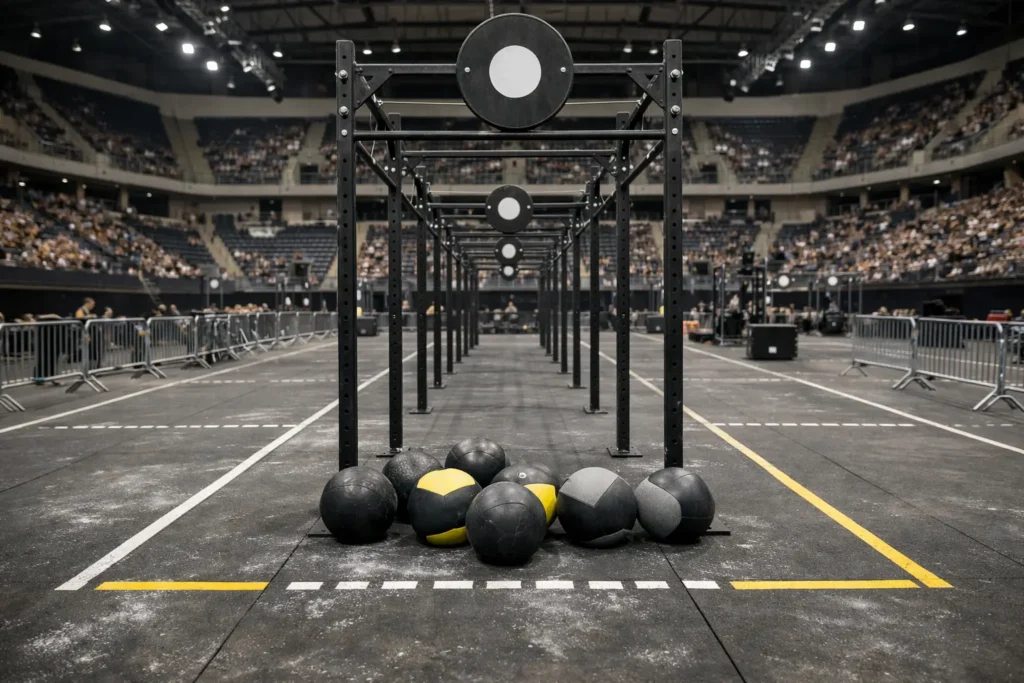
The sled push and sled pull are good examples. The load may be correct, but if the sled does not fully cross the required distance, the judge can require more work. On wall balls, athletes lose time when reps fail to hit the correct target height. On sandbag lunges, incomplete extension or missed lane distance can create unnecessary extra effort.
- Do not shorten the sled lane or stop early
- Keep full control of the kettlebells during farmers carry
- Hit the correct wall ball target every rep
- Stand fully upright on sandbag lunges
- Train movement standards, not just the weight itself
This matters because once fatigue builds, technique usually breaks before strength does. That is why smart athletes practice official standards with official HYROX weights during training sessions. They do not wait until race day to discover that their wall balls are too low or that their lunge extension is incomplete.
For first-time competitors, this is another reason why the HYROX beginner guide is worth reading before race day. It helps reduce avoidable penalties and gives you a clearer picture of what judges actually care about.
FAQ – HYROX Weights
How heavy is the sled push in HYROX?
The sled push weight in HYROX ranges from about 102 kg for Open Women to 202 kg for Pro Men. The exact load depends on the division you compete in.
Do HYROX weights change between events?
No. Official HYROX weights are standardized across all global events to ensure fairness and consistency.
What is the heaviest station in HYROX?
The sled push is widely considered the heaviest station because it combines significant weight with accumulated fatigue.
Are HYROX weights different for doubles?
Yes. In doubles, athletes share the workload and usually perform the same weights as the Open division but split repetitions.
Can beginners handle HYROX weights?
Yes. The Open division is designed for beginners, with weights that are challenging but achievable with proper preparation.
Final Verdict
Understanding the official HYROX weights is essential if you want to perform well during the race. The sled push, sled pull, farmers carry, and wall balls are the stations where strength preparation matters most.
Training with the correct loads and simulating race fatigue will make these stations far more manageable on race day.