





New to HYROX and not sure where to start?
This page is your complete HYROX beginner guide — designed to give you clarity, structure, and direction.
You’ll learn what HYROX is, how the race works, how to train properly, what gear really matters, and how to prepare for your first HYROX event without overthinking.
Quick Start (Read This First)
If you want the shortest path to a solid first HYROX race, follow this checklist. It is designed for beginners who want structure, not overwhelm.
- Pick your division: Open is the best default for most first-timers (Singles → Open).
- Train 8–12 weeks: build running capacity + station efficiency.
- Prioritize pacing: aim for “controlled” runs and smooth transitions, not early hero efforts.
- Practice the hard stations: sleds, lunges, and wall balls usually decide outcomes.
- Choose stable running shoes: good grip for sled work, still efficient for 8 km total running.
- Register early: popular events sell out fast, especially in major cities.
If you want a step-by-step path, use the sections below or jump directly to our HYROX Beginner Guide, Training Guides, and Gear Guide.
What is HYROX?

HYROX is an indoor fitness race that combines running and functional workouts. The concept is simple: you run, then you complete a workout station, then you run again — until you finish all segments.
What makes HYROX unique is standardization. Every athlete completes the same race format, with the same station order and the same movement standards. That makes HYROX measurable and comparable across cities and countries — whether you race in Berlin, London, New York, or Singapore.
A typical HYROX race alternates between running segments and workout stations, creating a unique “compromised” challenge. You are not just running. You are running while managing fatigue from sleds, lunges, rowing, and wall balls. That is why HYROX rewards endurance, strength, and smart pacing.
The HYROX Race Format (Simple Breakdown)
Every standard HYROX race follows the same structure:
- 8 × 1 km runs (8 km total)
- 8 workout stations in between runs
This is why HYROX results are comparable across events. If you improve your time in one city, you can benchmark it globally.
The 8 HYROX Workout Stations
In the standard race order, HYROX stations are:
- SkiErg (machine-based endurance effort)
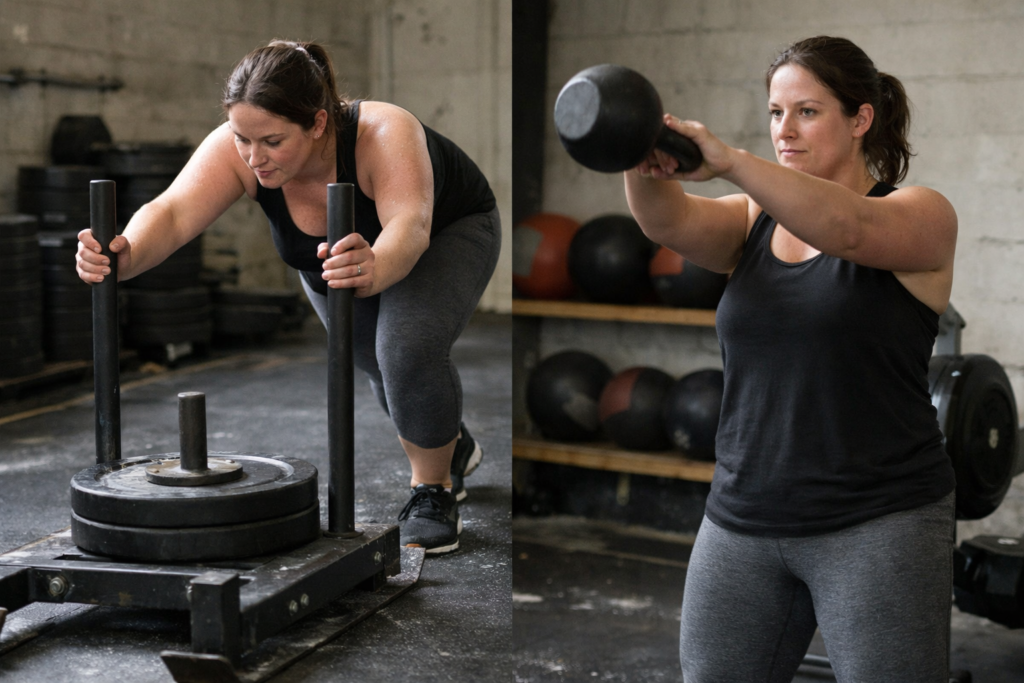
- Sled Push (heavy drive through the floor)
- Sled Pull (upper-body + legs under fatigue)
- Burpee Broad Jumps (high heart-rate + coordination)
- Rowing (engine + rhythm, often underestimated)
- Farmers Carry (grip + posture while moving)
- Sandbag Lunges (leg burn + pacing discipline)
- Wall Balls (high-rep fatigue, most common “blow-up” station)
If you want a deeper breakdown of standards, common mistakes, and pacing strategies for each station, start with our Beginner Guide and Training Guides.
Who Is This Guide For?
- Athletes discovering HYROX for the first time
- Beginners preparing for their first HYROX race
- Cross-training athletes (running, CrossFit, fitness racing)
- Anyone confused by divisions, rules, or race format
If you’re motivated but slightly overwhelmed, that is normal. HYROX combines endurance, functional fitness, competition rules, and event logistics — and most beginner information online is scattered.
How to Start HYROX
1. Learn the Basics
Understand the race format, divisions, movement standards, and what to expect on race day.
2. Train With Structure
3. Choose the Right Gear
Shoes, apparel, and accessories matter more than you think — especially over long, intense races.
4. Prepare for Your Event
HYROX doesn’t reward randomness. It rewards preparation.
HYROX Divisions Explained (Pick the Right One)
On the official registration page, you’ll often see Singles, Doubles, and Relay. “Singles” simply means you race individually — then you choose a division such as Open or Pro (and sometimes Age Group).
- Open: the best default for most first-time athletes.
- Pro: heavier weights and higher performance expectations.
- Doubles: share the workload across all stations with a partner.
- Relay: team format split between multiple athletes.
- Age Group: competitive category based on age brackets (availability varies by event).
If you want the detailed differences (weights, who each division fits, and common beginner mistakes), see HYROX Divisions Explained.
How Hard Is HYROX?
HYROX is difficult in a specific way: it blends steady running with repeated strength-endurance stations. Many beginners underestimate how hard it is to run “normally” right after heavy sleds or high-rep lunges.
Runners often struggle with sleds and wall balls because strength-endurance is the limiter. Lifters often struggle with the total running volume and the repeated 1 km segments under fatigue.
The biggest mistake is going too hard early. If you sprint the first runs, you will usually pay for it later at lunges and wall balls. HYROX rewards athletes who stay controlled early and keep their stations efficient.
HYROX for Beginners – What to Expect on Race Day
Your first HYROX feels intense, but the flow is simple once you understand it. Most events follow the same rhythm: check-in, warm-up, start time, then a continuous loop of run → station → run until you finish.
- Check-in: arrive early, pick up your bib, and confirm your start wave.
- Warm-up: keep it light. You want to feel ready, not tired.
- Start wave: the first 1 km run often feels “too easy.” Stay controlled.
- Stations: focus on smooth reps and clean standards. Rushing often creates no-reps and wasted energy.
- Transitions: practice calming your breathing when switching between running and stations.
Beginner mistake #1: treating the first half like a sprint. Beginner mistake #2: stopping too long between reps at wall balls and lunges. A steady rhythm usually beats aggressive bursts with long breaks.
Average HYROX Finish Times (Benchmarks)
HYROX finish times depend on running ability, station efficiency, and how well you handle fatigue. As a beginner, your goal should be to finish strong with good pacing — not to chase elite times immediately.
| Division | Typical Beginner Range | Competitive Range |
|---|---|---|
| Singles Open (Men) | 1:20–1:45 | 1:05–1:20 |
| Singles Open (Women) | 1:25–1:55 | 1:10–1:30 |
| Singles Pro | Varies (heavier loads) | Top athletes often sub-1:10 |
| Doubles | Depends on team balance | Often faster than Solo Open |
These are broad benchmarks. Course layout, venue size, and judging can affect final time. The fastest improvement for most beginners comes from better pacing, fewer long breaks on wall balls, and smoother transitions.
How to Train for HYROX (Beginner Framework)
Beginners improve fastest when training is simple and structured. Your goal is not to “survive” workouts — it’s to build repeatable performance under fatigue.
A simple weekly structure (8–12 weeks)
- Run 2–3x/week: one easy aerobic run, one interval session, one compromised run (optional).
- Stations 2x/week: sleds, lunges, wall balls, and technique under fatigue.
- Strength maintenance: 1–2 sessions focused on legs, posterior chain, and core.
- Recovery: sleep, nutrition, and one easy day before your hardest workout.
Key training idea: HYROX is about repeatability. You want to complete stations with controlled effort, then return to running without collapsing.
For programs and weekly templates, go to HYROX Training Guides.
HYROX Gear That Actually Matters
Most beginners overthink gear — but a few items genuinely impact performance and comfort.
- Shoes: stable enough for sled push/pull, still efficient for running.
- Grip: useful for farmers carry and pulling mechanics (optional, but valuable for some athletes).
- Apparel: avoid anything that chafes during lunges and wall balls. Prioritize comfort.
- Socks: underrated. Blisters can ruin your race faster than “bad fitness.”
See our tested recommendations in the HYROX Gear Guide.
How to Register & Choose Your First Event
HYROX registration is done on the official event page for your city. Pick your location, choose your race format (Singles/Doubles/Relay), then select your division (Open/Pro/Age Group where available).
If you want help choosing the right event, start here: HYROX Events Guide.
Is HYROX Good for Weight Loss?
HYROX training can support fat loss because it combines running volume, strength endurance, and high weekly training consistency. The race itself is intense, but the main driver of weight loss is still your overall calorie balance and daily habits.
If your goal is fat loss, focus on a realistic training schedule you can sustain, prioritize recovery, and keep nutrition simple. Most athletes make faster progress by training consistently and avoiding “all-out” sessions every day.
Why HYROX Feels Confusing at First
HYROX combines running, functional workouts, competition rules, and event logistics. For beginners, this mix can feel overwhelming — not because HYROX is too complex, but because information is often scattered.
This site exists to simplify HYROX, remove noise, and give you clear, actionable guidance.
How to Use HYROX Insider
You don’t need to read everything at once. Use a simple path depending on your goal.
Recommended order:
- Start with Beginner guides
- Follow structured Training content
- Optimize with the right Gear
- Prepare your Event strategy
HYROX Insider is designed to guide you step by step — not overwhelm you.
Where are you in your HYROX journey?
Choose your path and get straight to what matters.

New to HYROX? Start with the basics

Training for your first race (or improving your time)?
Follow structured plans combining running and HYROX workouts.

Not sure what gear you really need?
Shoes, grips, belts, and essentials tested for HYROX performance.

Looking for your next HYROX event?
Dates, locations, divisions, and race-day rules explained.
FAQ – HYROX Beginners
Can beginners really finish HYROX?
Yes. The Open division is designed to be accessible for first-timers. The key is pacing, learning movement standards, and training consistently for at least 8–12 weeks.
How long should I train before my first HYROX race?
Most beginners do best with 8–12 weeks of structured training. If you already run regularly, you may need less time. If running is your weak point, prioritize it early.
What is the hardest HYROX station?
For many athletes, wall balls and sled push are the biggest “make or break” stations. The hardest station is usually the one that exposes your weakest capacity under fatigue.
Is HYROX harder than a marathon?
They are hard in different ways. A marathon is pure endurance over a long distance. HYROX is shorter but combines running with repeated strength-endurance stations, creating a different kind of fatigue.